
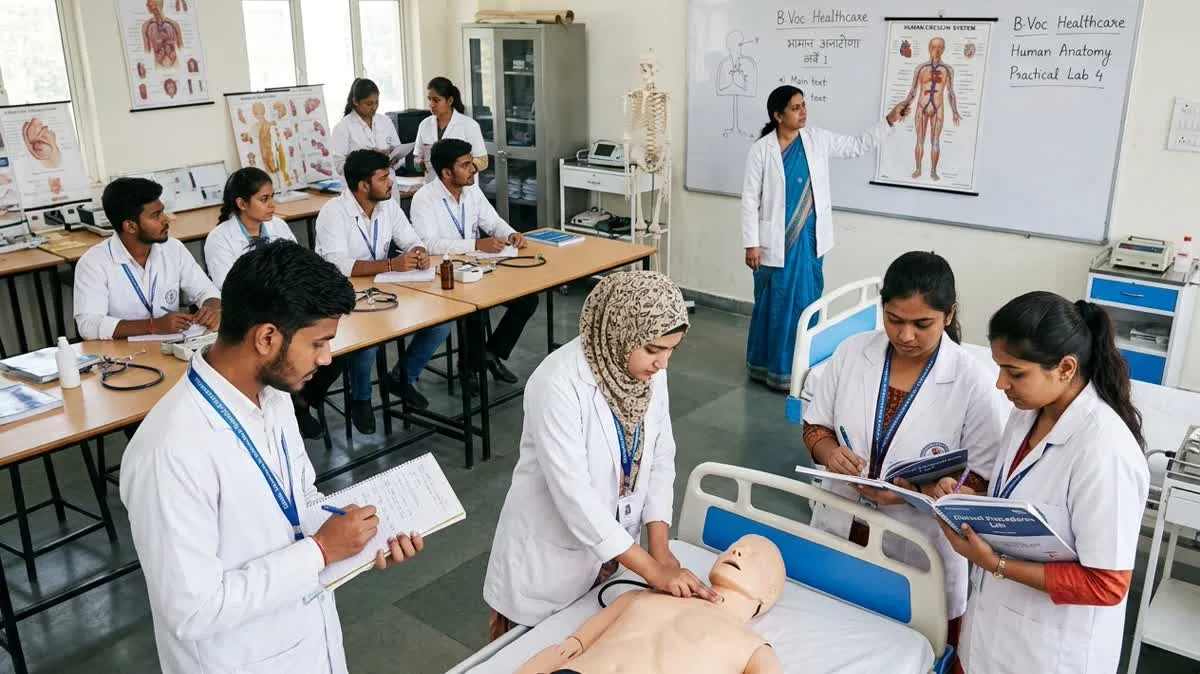
The traditional college degree model—heavy on rote theoretical textbooks and light on actual workplace skills—is rapidly being superseded by modern vocational education. In the healthcare sector, the Bachelor of Vocation (B.Voc) has emerged as the most successful, employment-aligned undergraduate model approved by the University Grants Commission (UGC) and the National Skills Qualifications Framework (NSQF).
Allied Healthcare Industry Benchmarks in India & Global • OSPMC Ambala. Below is the visual clinical protocol flowchart:
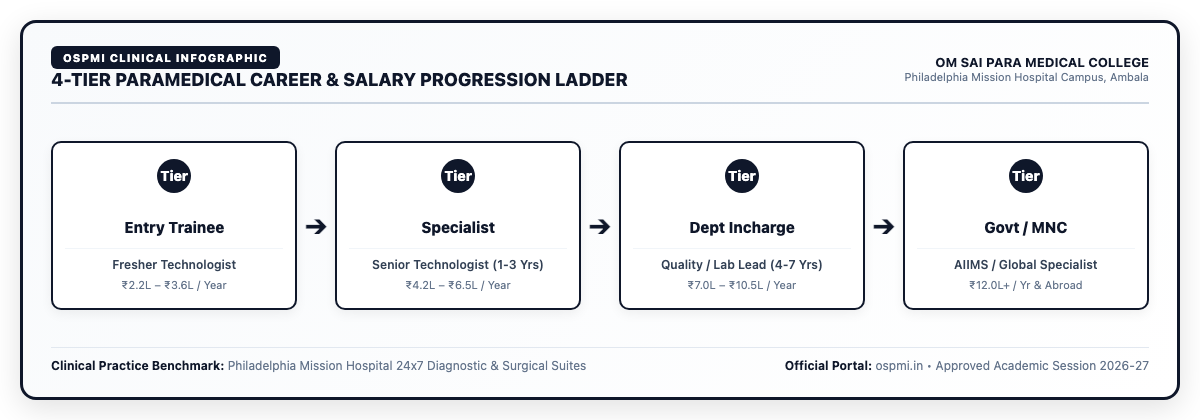
| Career Stage | Typical Designation | Key Responsibilities | Estimated Compensation |
|---|---|---|---|
| Tier 1: Entry Level | Junior Medical Technologist / OT Assistant | Routine clinical benchwork, sample processing, patient prep | ₹18,000 – ₹28,000 / month |
| Tier 2: Mid Level | Senior Technologist / Modality Specialist | CT/MRI operation, complex surgery scrub, dialysis shifts | ₹35,000 – ₹52,000 / month |
| Tier 3: Leadership | Department Supervisor / Quality Assurance Lead | NABL / NABH accreditation, shift rosters, QC audit sign-off | ₹55,000 – ₹85,000 / month |
| Tier 4: Govt / Global | Central Govt Officer (AIIMS) / Medical Device MNC Lead | Clinical application specialist, healthcare officer (7th CPC) | ₹80,000 – ₹1,50,000+ / month |
The Core Philosophy of B.Voc: 60% Hospital Practical + 40% Medical Theory
Unlike conventional university degrees where students spend three years in lecture halls, B.Voc programs are designed in active partnership with healthcare employers. The curriculum is structurally divided:
- 60% On-the-Job Hospital Training: Daily clinical postings in active diagnostic pathology labs, operating rooms, radiology suites, and dialysis units.
- 40% Foundational Medical Science: Human anatomy, clinical pathology, biochemistry, pharmacology, and medical law.
The Multiple Exit System: Never Lose an Academic Year
One of the greatest advantages of the UGC B.Voc program is its modular exit structure. If a student faces personal, financial, or employment circumstances that prevent completing all 3 years consecutively, their effort is never wasted:
- Exit after Year 1 (NSQF Level 5): Awarded a recognized Diploma. Ready for entry-level technician roles.
- Exit after Year 2 (NSQF Level 6): Awarded an Advanced Diploma. Ready for supervisory technician roles.
- Complete Year 3 (NSQF Level 7): Awarded the full Bachelor of Vocation (B.Voc) Degree. Fully eligible for Master's programs, government exams (UPSC, State PSC), and senior hospital management.
Specializations Available at OSPMC Ambala
OSPMC Ambala offers recognized B.Voc degrees across 8 healthcare specialties: Medical Lab Technology (MLT), Operation Theatre Technology (OTT), Radiology (RMIT), Dialysis Technology, Cardiac Care, Hospital Sterilization (CSSD), Patient Care Management, and Dietetics & Nutrition.
Official 2026-27 Fee Structure and Installments
At Om Sai Para Medical College (OSPMC), Ambala, the annual tuition fee is payable in 3 installments every year:
• Diploma Programs (DMLT, OTT, Optometry, Dialysis, Cath Lab): ₹50,000 / year (₹15,000 + ₹17,500 + ₹17,500)
• B.Voc Degree Programs: ₹55,000 / year (₹15,000 + ₹20,000 + ₹20,000)
• B.Sc Degree Programs and BMLS: ₹60,000 / year (₹20,000 + ₹20,000 + ₹20,000)
• Admission form: ₹2,000 (one time). Examination fee: ₹1,000 per semester (Diploma, B.Voc), ₹2,000 per semester (B.Sc, BMLS)
0 comments
Be the first to comment on this article.