
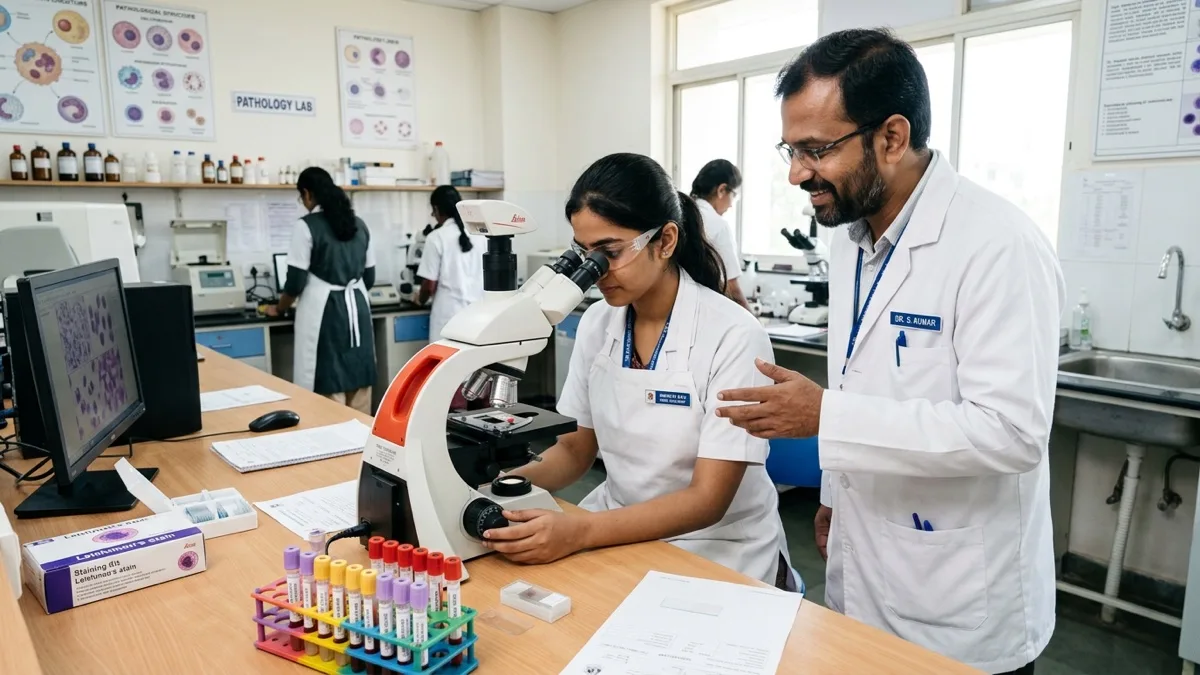
The Diploma in Medical Laboratory Technology (DMLT) at Om Sai Para Medical College (OSPMI), Ambala is a rigorous, job-ready 2-year professional healthcare program. Operating directly within the active clinical ecosystem of Philadelphia Mission Hospital (Est. 2004), students receive immersive daily training on modern automated pathology analyzers, digital microscopes, and clinical specimen diagnostics under the direct supervision of experienced pathologists and microbiologists.
DMLT Program Snapshot & Executive Summary
| Program Parameter | Course Specification (OSPMI Ambala) |
|---|---|
| Course Level | Undergraduate Paramedical Diploma (2 Years Full-Time) |
| Program Duration | 2 Academic Years (Includes mandatory clinical hospital postings) |
| Minimum Eligibility | 10+2 Pass in Science (PCB/PCM) or recognized equivalent stream (Min. 45% aggregate) |
| Admission Mode | Direct Merit-Based Counselling (No NEET score required for 2026-27 batch) |
| Annual Tuition Fee | ₹36,000 per year (Payable in 2 approved term installments: ₹18,000 at admission + ₹18,000 in November) |
| Clinical Hospital Campus | Philadelphia Mission Hospital campus, Ambala City (Active 100+ bed hospital) |
| Key Career Outcomes | Medical Lab Technician, Clinical Biochemist, Phlebotomist, Blood Bank Technologist |
| Top Placement Sectors | Civil Hospitals (NHM Haryana), Dr Lal PathLabs, SRL Diagnostics, Metropolis, Max Healthcare, Fortis |
Detailed 2-Year Clinical Curriculum & Syllabus Modules
The DMLT syllabus at OSPMI is structured in strict alignment with national paramedical council standards, blending comprehensive medical classroom theory with over 600 hours of supervised laboratory benchwork.
Year 1: Pre-Clinical Sciences & Foundational Laboratory Techniques
- Clinical Hematology & Hemocytometry: RBC, WBC, and Platelet manual counts using improved Neubauer counting chamber; Hemoglobin estimation (Sahli's and Cyanmethemoglobin methods); ESR determination (Westergren and Wintrobe methods); Packed Cell Volume (PCV/Hematocrit).
- Peripheral Blood Smears & Staining: Preparation, fixation, and staining of thin and thick blood smears using Leishman, Giemsa, and Wright stains; Differential Leukocyte Count (DLC) and identification of abnormal cells.
- Clinical Pathology & Body Fluid Analysis: Routine and microscopic examination of urine (physical, chemical dipstick for glucose/protein/ketones, microscopic examination for casts, crystals, epithelial cells, and pus cells); Stool examination for helminthic ova and protozoal cysts; Semen analysis (motility and sperm count).
- General Human Anatomy & Medical Physiology: Fundamental histology of human tissues, structure of cardiovascular, respiratory, digestive, renal, and endocrine organ systems; Hemostasis and blood coagulation pathways.
- Clinical Biochemistry I: Principles of laboratory colorimetry, preparation of normal, molar, and standard solutions; Quantitative estimation of blood glucose (GOD-POD method), blood urea nitrogen (BUN), and serum creatinine.
Year 2: Advanced Clinical Diagnostics, Microbiology & Hospital Rotations
- Medical Microbiology & Serology: Morphology, classification, and cultivation of pathogenic bacteria; Preparation of culture media (Nutrient Agar, Blood Agar, MacConkey Agar); Gram staining and Ziehl-Neelsen (ZN) acid-fast staining for Mycobacterium tuberculosis; Antibiotic susceptibility testing (Kirby-Bauer disc diffusion method).
- Immunology & Immuno-hematology (Blood Banking): ABO and Rh blood group typing (tile and tube methods); Cross-matching (major and minor); Direct and Indirect Coombs (antiglobulin) tests; Serological testing (Widal slide/tube agglutination, VDRL/RPR for syphilis, Rapid Card and ELISA tests for HIV, HBsAg, HCV, and Dengue).
- Clinical Biochemistry II & Automation: Operation and calibration of fully automated and semi-automated clinical chemistry analyzers; Liver Function Tests (Total and Direct Bilirubin, SGOT/AST, SGPT/ALT, Alkaline Phosphatase); Serum Lipid Profile (Cholesterol, Triglycerides, HDL, LDL); Electrolyte analysis (Sodium, Potassium, Chloride via ISE); Internal quality control (LJ charts and Westgard rules).
- Histopathology & Cytology Techniques: Receiving, grossing assistance, and 10% neutral buffered formalin fixation of surgical specimens; Tissue processing, dehydration, clearing, and paraffin wax block embedding; Microtomy (rotary microtome knife sharpening, trimming, and ribbon cutting at 3–5 microns); Hematoxylin & Eosin (H&E) staining; Cytological smear preparation and Papanicolaou (PAP) staining.
- Hospital Clinical Postings: Rotational postings inside Philadelphia Mission Hospital's active Central Diagnostic Laboratory, Emergency Trauma Stat Lab, Blood Bank, and Outpatient Phlebotomy Station.
Hands-On Diagnostic Machinery & Laboratory Equipment Mastered
Unlike non-clinical training institutes, OSPMI students gain hands-on proficiency on real diagnostic instruments installed in our active hospital diagnostic laboratory:
- Automated Clinical Chemistry Analyzers: Semi-automated photometers (Erba Chem 5X / Transasia) and fully automated serum biochemistry systems for metabolic panels.
- 3-Part & 5-Part Differential Hematology Cell Counters: Automated complete blood count (CBC) analyzers with automated leukocyte differentiation, impedance technology, and flag verification.
- Microplate ELISA Readers & Automated Washers: 96-well spectrophotometric readers for thyroid hormonal assays, infectious viral serology, and autoimmune markers.
- Rotary Microtomes & Tissue Floating Baths: Precision tissue block sectioning instruments for histopathology and oncological biopsy preparation.
- Binocular & Trinocular Research Microscopes: High-definition oil-immersion optical microscopy for cellular morphology, malarial parasite detection, and microbiological cytology.
- High-Speed Refrigerated Centrifuges: Plasma, serum, and component separation workstations operating at controlled temperatures.
- Sterilization Equipment: Vertical and horizontal pressure steam autoclaves, hot air ovens, and biosafety cabinets (Class II Type A2) for safe specimen processing.
Clinical Hospital Training at Philadelphia Mission Hospital Campus
The definitive advantage of pursuing DMLT at OSPMI is the campus setting: Philadelphia Mission Hospital, Ambala City. Established in 2004, the college is embedded within an active hospital infrastructure. Students do not learn from dry textbooks alone; they actively participate in:
- Direct Phlebotomy & Patient Interaction: Mastering vacuum tube (vacutainer) blood collection techniques across adult, pediatric, and geriatric patients under clinical supervision.
- Emergency 24x7 Stat Testing: Experiencing real hospital emergency workflows where rapid cardiac biomarker (Troponin-I), arterial blood gas, and cross-match results must be communicated to ICU physicians within minutes.
- Biohazard Safety & Infection Control: Strict implementation of Biomedical Waste Management (BMW 2016 Rules), universal precautions, personal protective equipment (PPE), and post-exposure prophylaxis (PEP) protocols.
Career Opportunities, Salary Outlook & Progression in India
The diagnostic pathology industry in India is expanding at over 14% CAGR, driven by preventative healthcare, health insurance expansion, and corporate hospital networks. DMLT graduates from OSPMI enjoy strong employability across diverse healthcare settings:
| Career Role | Work Environment | Experience Level | Average Monthly Salary (INR) |
|---|---|---|---|
| Junior Medical Lab Technician | Diagnostic Chains / Nursing Homes | Fresher (0–1 Year) | ₹18,000 – ₹25,000 / month |
| Clinical Phlebotomist & Sample In-Charge | Corporate Laboratories / Collection Centers | 1–3 Years | ₹24,000 – ₹32,000 / month |
| Senior Pathology & Blood Bank Technologist | Multi-Specialty Corporate Hospitals | 3–6 Years | ₹35,000 – ₹48,000 / month |
| Government Laboratory Technician (NHM / AIIMS) | State Civil Hospitals / AIIMS / Railway Hospitals | Entry Exam Qualified | ₹29,200 – ₹52,000 / month (Pay Level 5) |
| Lab In-Charge / NABL Quality Coordinator | Accredited Reference Pathology Laboratories | 6+ Years | ₹50,000 – ₹75,000+ / month |
Frequently Asked Questions (FAQs) - DMLT Course
Q1: What is the full form of DMLT?
DMLT stands for Diploma in Medical Laboratory Technology. It is a 2-year undergraduate professional diploma program that trains candidates to perform clinical diagnostic tests on patient blood, urine, tissue, and bodily fluid samples.
Q2: Can I apply for DMLT without appearing for the NEET examination?
Yes, absolutely. NEET is not required for DMLT admission at OSPMI Ambala. Admissions for the 2026–27 session are conducted directly through merit counselling based on your 10+2 board marks.
Q3: What higher education degrees can I pursue after completing DMLT?
After completing DMLT, students can gain lateral entry directly into the 2nd Year of B.Sc. Medical Lab Technology (B.Sc. MLT) or pursue a UGC-aligned Bachelor of Vocation (B.Voc MLT) degree, followed by Master's degrees (M.Sc. MLT) in specialized disciplines such as Clinical Biochemistry or Medical Microbiology.
Q4: Is hospital clinical training included in the college curriculum?
Yes. OSPMI is located on the campus of Philadelphia Mission Hospital in Ambala City. Daily clinical rotations across outpatient phlebotomy, emergency stat diagnostics, hematology, and microbiology are an integral part of the curriculum.
Q5: How can I pay the annual course fees at OSPMI?
OSPMI provides a student-friendly 2-term installment facility. The approved annual tuition fee of ₹36,000 can be paid as: 1st Installment (At Admission): ₹18,000; 2nd Installment (November): ₹18,000.
Direct WhatsApp Admission Helpline — Diploma in Medical Lab Technology (DMLT)
Have questions regarding eligibility, seat availability, installment fee options, or Philadelphia Mission Hospital rotations? Connect directly with our Senior Admission Counsellor on WhatsApp for instant guidance.
Chat with Admission Team on WhatsAppEligibility
Minimum Qualification: 10+2 Pass from a recognized educational board (CBSE, HBSE, ICSE, or State Boards). Candidates from any stream (Science PCB/PCM preferred) with minimum 45% aggregate marks are eligible.
Age Limit: Minimum 17 years at the time of admission. Direct merit counselling open for 2026-27 batch (No NEET required).
Fees
Official Annual Tuition Fee (2026-27 Session): ₹36,000 per year
Approved 2-Term Installment Schedule:
- 1st Installment (At the Time of Admission): ₹18,000/-
- 2nd Installment (Month of November): ₹18,000/-
- Grand Total Fee per Year: ₹36,000/-
Institutional Fee Regulations:
- Examination & Registration Fee: Extra as per University and Board Norms.
- Hospital Practical Rotations: Diploma awarded by recognized board / IIPMT Punjab & IPH&H New Delhi. Clinical postings at Philadelphia Mission Hospital included.
- Installment Deadlines: 2nd installment is strictly payable in the month of November.