
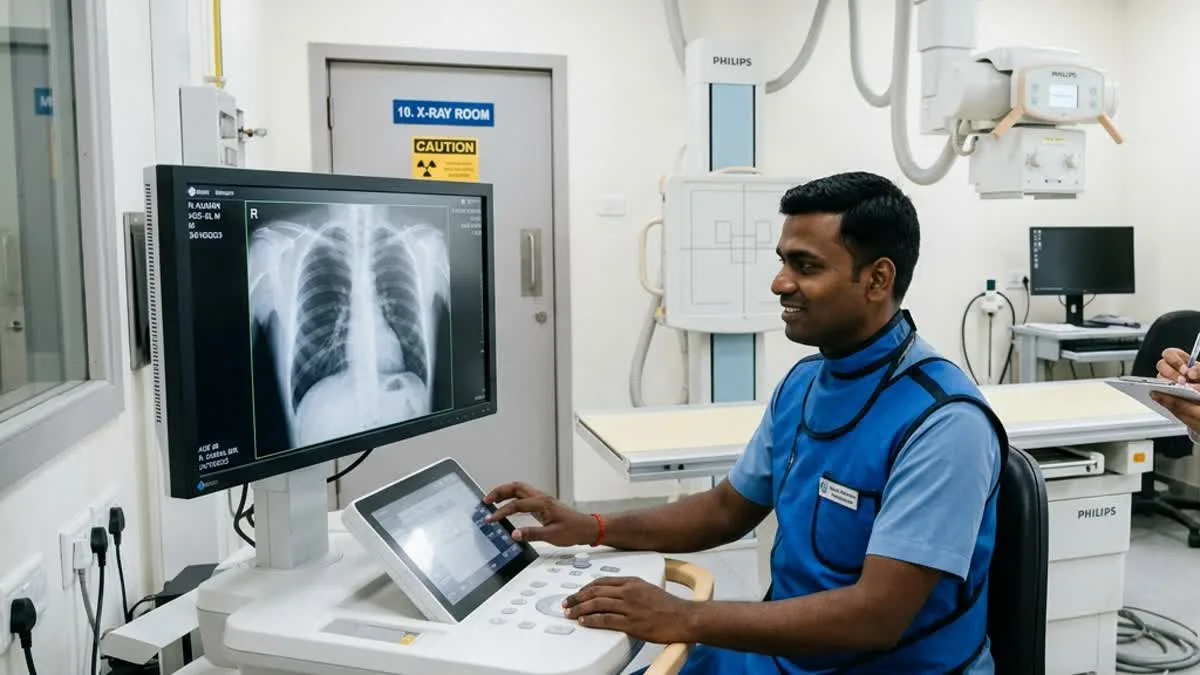
The B.Voc in Radiology and Medical Imaging Technology (RMIT) at Om Sai Para Medical College (OSPMI), Ambala is a 3-year professional vocational undergraduate program. Operating within Philadelphia Mission Hospital, students acquire comprehensive mastery over Digital X-Ray, Multi-Slice Computed Tomography (CT), Magnetic Resonance Imaging (MRI), and AERB radiation protection protocols.
B.Voc Radiology and Medical Imaging Technology (RMIT) Program Snapshot & Executive Summary
| Program Parameter | Course Specification (OSPMI Ambala) |
|---|---|
| Course Level | UGC-Approved Vocational Degree (3 Years Full-Time) |
| Program Duration | 3 Years (Includes active clinical hospital postings) |
| Minimum Eligibility | 10+2 Pass in Science (PCB/PCM) or recognized stream (Min. 45% aggregate) |
| Admission Mode | Direct Merit-Based Counselling (No NEET score required for 2026-27 batch) |
| Annual Tuition Fee | ₹50,000 / year (Payable in 2 approved term installments: ₹25,000/- at admission + ₹25,000/- in November) |
| Clinical Hospital Campus | Philadelphia Mission Hospital campus, Ambala City (Radiology, CT Scan & Diagnostic Imaging Center) |
| Affiliation & Recognition | UGC Aligned / University Affiliated / State Paramedical Board Recognized |
Detailed Clinical Curriculum & Syllabus Modules
The academic syllabus at OSPMI is structured in strict alignment with national paramedical council standards, blending comprehensive classroom theory with supervised hospital clinical benchwork.
Year 1: Radiographic Physics, Human Anatomy & Digital X-Ray
- Radiological Physics & Radiation Quantities: Atomic structure, X-ray generation, Bremsstrahlung and characteristic radiation, inverse square law, and half-value layers.
- Radiographic Anatomy & Positioning I: Skeletal and chest radiographic positioning, cranial views, pelvic views, and beam centralisation techniques.
- Digital Radiography & Image Receptors: Computed radiography (CR) phosphor plates, flat-panel digital detectors (FPD), and PACS network architecture.
- Radiation Protection & AERB Standards: Biological effects of ionizing radiation, ALARA principle, lead aprons, thyroid shields, and TLD dosimeter monitoring.
Year 2: Special Procedures, Contrast Media & Computed Tomography (CT)
- Special Radiographic Procedures: Barium swallow, Barium meal follow-through, Intravenous Urography (IVU), Hysterosalpingography (HSG), and MCU.
- Radiological Contrast Media: Ionic and non-ionic iodinated contrast media, barium sulfate, adverse reactions, and emergency anaphylaxis management.
- Computed Tomography (CT) Principles: CT generations, helical/spiral scanning, slip-ring technology, detector arrays, pitch, Hounsfield units, and image reconstruction.
- Clinical CT Protocols: Non-contrast CT brain for trauma, CT chest, high-resolution CT (HRCT) lungs, and contrast-enhanced CT (CECT) abdomen.
Year 3: Magnetic Resonance Imaging (MRI), Ultrasound Principles & Advanced Imaging
- Magnetic Resonance Imaging (MRI) Physics: Nuclear magnetic resonance, T1 and T2 relaxation times, spin echo, gradient echo sequences, and MRI safety zones.
- Clinical MRI Protocols: MRI brain, spine (cervical, lumbar), joint imaging (knee, shoulder), and magnetic resonance angiography (MRA).
- Diagnostic Ultrasonography Basics: Piezoelectric transducers, B-mode, M-mode, color Doppler principles, and acoustic shadowing artifacts.
- Full-Year Clinical Radiology Internship: Rotational postings inside Philadelphia Mission Hospital Diagnostic Radiology and CT suites.
Hands-On Clinical Machinery & Equipment Mastered
Unlike non-clinical institutions, OSPMI students gain direct operational mastery over high-precision equipment installed at Philadelphia Mission Hospital:
- High-Frequency Digital X-Ray Systems: 500mA digital radiography units with automated exposure control (AEC) and motorized bucky tables.
- Computed Radiography (CR) Readers: Multi-plate laser digitizers delivering high-contrast diagnostic images within seconds.
- Multi-Slice Spiral CT Scanners: Fast helical CT scanners capable of sub-millimeter volumetric isotropic imaging and 3D reconstructions.
- PACS & DICOM Diagnostic Consoles: Dual-monitor diagnostic reading stations for image manipulation, windowing, and measurement.
- Radiation Safety & Dosimetry Tools: Lead barriers, gonadal shields, mobile lead protective screens, and BARC-calibrated TLD badges.
Clinical Hospital Postings at Philadelphia Mission Hospital
The core competitive advantage of studying at OSPMI is our direct physical campus integration with Philadelphia Mission Hospital, Ambala City. Established in 2004, the hospital provides live daily case exposure:
- Emergency Trauma Radiography Postings: Managing acute polytrauma cases requiring rapid spinal and extremities digital radiography in the ER.
- Fluoroscopic Contrast Examination Assistance: Assisting consultant radiologists during real-time fluoroscopic gastrointestinal and genitourinary investigations.
- Patient Radiation Dose Optimization: Calibrating tube voltage (kVp) and current-time product (mAs) to minimize patient exposure while maximizing diagnostic yield.
Career Scope, Salary Matrix & Employment Outlook in India
Allied healthcare and paramedical technologies represent one of India's fastest-growing employment sectors. OSPMI graduates command strong starting salaries with rapid career progression:
| Designation / Role | Workplace Environment | Experience | Average Salary Scale (INR) |
|---|---|---|---|
| Junior Radiologic Technologist | Diagnostic Imaging Centers / Hospitals | Fresher (0–1 Year) | ₹24,000 – ₹32,000 / mo |
| CT / MRI Technologist | Multi-Specialty Corporate Hospitals | 1–3 Years | ₹32,000 – ₹45,000 / mo |
| Chief Radiology Technologist / Dept Head | Super-Specialty Hospitals & Diagnostic Chains | 3–6 Years | ₹48,000 – ₹68,000 / mo |
| Government Radiographer (AIIMS / State Health) | Central Government Medical Institutes | Exam Qualified | ₹35,400 – ₹67,000 / mo (Pay Level 6) |
| Medical Imaging Applications Specialist | MNCs (GE Healthcare, Siemens Healthineers, Philips) | 5+ Years | ₹65,000 – ₹1,20,000+ / mo |
Frequently Asked Questions (FAQs) - B.Voc Radiology and Medical Imaging Technology (RMIT)
Q1: What is the career scope after B.Voc RMIT?
Graduates work as Radiographers, CT Scan Technologists, MRI Technologists, and Application Specialists in corporate hospitals, diagnostic centers, and medical imaging MNCs.
Q2: Is NEET required for B.Voc RMIT?
No. Admission to B.Voc RMIT at OSPMI is merit-based based on 10+2 marks.
Q3: What is the annual fee for B.Voc RMIT at OSPMI?
The approved annual tuition fee is ₹50,000 per year, payable in 2 installments: ₹25,000 at admission and ₹25,000 in November.
Q4: Where will clinical imaging practicals take place?
All practical sessions take place at the Philadelphia Mission Hospital campus in Ambala City on live diagnostic equipment.
Q5: Can B.Voc RMIT graduates work abroad?
Yes. Radiologic technologists are in massive global demand across the Gulf (DHA/HAAD exams), UK (HCPC), and Canada.
Direct WhatsApp Admission Helpline — B.Voc Radiology and Medical Imaging Technology (RMIT)
Have questions regarding eligibility, seat availability, installment fee options, or Philadelphia Mission Hospital rotations? Connect directly with our Senior Admission Counsellor on WhatsApp for instant guidance.
Chat with Admission Team on WhatsAppEligibility
Minimum Qualification: 10+2 Pass from a recognized educational board (CBSE, HBSE, ICSE, or State Boards). Candidates with Science (PCB/PCM) with minimum 45% aggregate marks are eligible.
Age Limit: Minimum 17 years at the time of admission. Direct merit counselling open for 2026-27 batch (No NEET required).
Fees
Official Annual Tuition Fee (2026-27 Session): ₹50,000 / year per year
Approved 2-Term Installment Schedule:
- 1st Installment (At the Time of Admission): ₹25,000/-
- 2nd Installment (Month of November): ₹25,000/-
- Grand Total Fee per Year: ₹50,000 / year
Institutional Fee Regulations:
- Examination & Registration Fee: Charged separately as per University and Board Norms.
- Hospital Practical Training: Daily clinical rotations at Philadelphia Mission Hospital campus included in the tuition fee. Zero hidden laboratory charges.
- Installment Deadlines: 2nd installment is strictly payable in the month of November.