
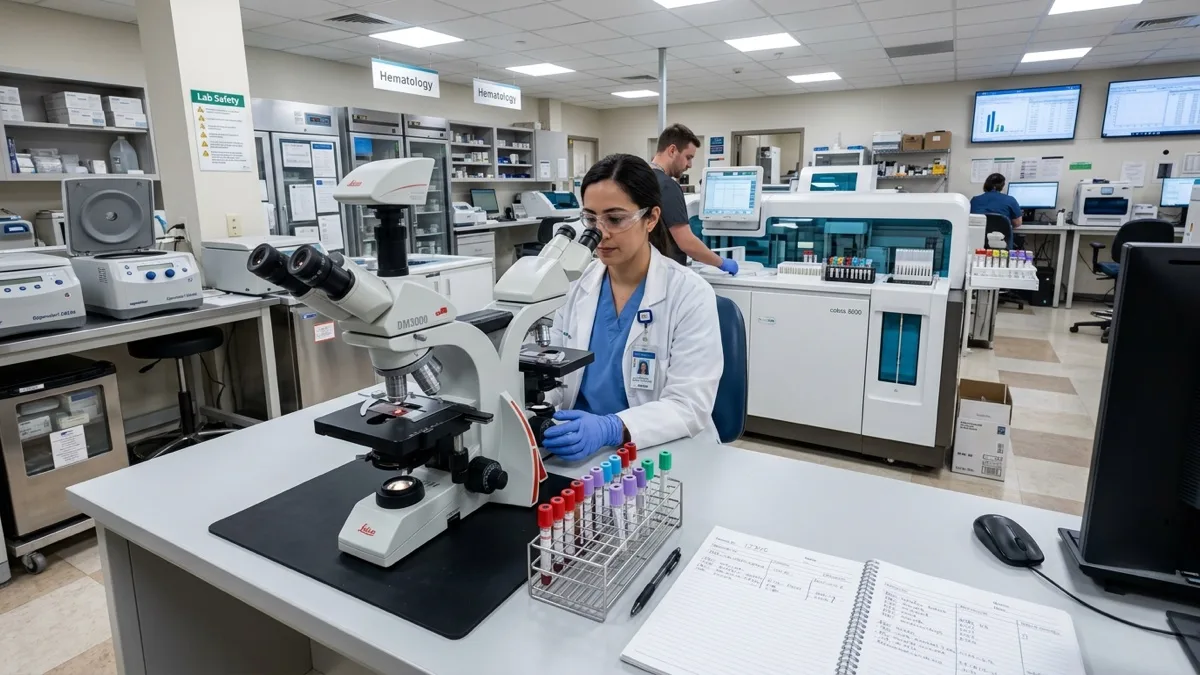
The Bachelors of Medical Laboratory Science (BMLS) at Om Sai Para Medical College (OSPMI), Ambala is a premier 3.5-year undergraduate university science degree (3 years academic coursework + 6 months intensive clinical internship). Operating at Philadelphia Mission Hospital, students are trained in clinical biochemistry, pathology, immunogenetics, molecular diagnostics, and laboratory management.
Bachelors of Medical Laboratory Science (BMLS) Program Snapshot & Executive Summary
| Program Parameter | Course Specification (OSPMI Ambala) |
|---|---|
| Course Level | University Undergraduate Science Degree (3.5 Years Full-Time) |
| Program Duration | 3.5 Years (Includes active clinical hospital postings) |
| Minimum Eligibility | 10+2 Pass in Science (PCB/PCM) or recognized stream (Min. 45% aggregate) |
| Admission Mode | Direct Merit-Based Counselling (No NEET score required for 2026-27 batch) |
| Annual Tuition Fee | ₹46,000 / year (Payable in 2 approved term installments: ₹23,000/- at admission + ₹23,000/- in November) |
| Clinical Hospital Campus | Philadelphia Mission Hospital campus, Ambala City (Central Diagnostic Pathology, Molecular Biology & Blood Bank) |
| Affiliation & Recognition | UGC Aligned / University Affiliated / State Paramedical Board Recognized |
Detailed Clinical Curriculum & Syllabus Modules
The academic syllabus at OSPMI is structured in strict alignment with national paramedical council standards, blending comprehensive classroom theory with supervised hospital clinical benchwork.
Year 1: Human Anatomy, Physiology, Foundations of Biochemistry & Hematology
- Human Anatomy & Systemic Physiology: Cellular ultrastructure, skeletal architecture, cardiovascular hemodynamics, and renal function.
- General Clinical Biochemistry: Biochemical principles of colorimetry, molar solutions, carbohydrates, proteins, and lipid metabolism.
- Hematology Fundamentals: Origin and development of blood cells (hematopoiesis), hemoglobin estimation, manual cell counts, and peripheral blood smears.
- Clinical Laboratory Safety & Biostatistics: Biosafety levels, chemical handling, biomedical waste management (BMW 2016), and statistical analysis of lab data.
Year 2: Systematic Microbiology, Immunohematology & Clinical Pathology
- Diagnostic Bacteriology & Mycology: Isolation and biochemical characterization of pathogenic bacteria, fungal slide cultures, and antimicrobial testing.
- Immunology & Blood Transfusion Science: Antigen-antibody reactions, complement cascades, ABO/Rh typing, major/minor cross-matching, and blood banking.
- Clinical Pathology & Body Fluid Analysis: Microscopic analysis of CSF, pleural, peritoneal, and synovial fluids, routine urinalysis, and semenology.
- Automated Clinical Chemistry I: Liver function tests, renal panels, lipid profiles, and operation of semi-automated clinical analyzers.
Year 3: Molecular Biology, Histopathology, Cytogenetics & Lab Management
- Histotechnology & Cytopathology: Tissue grossing assistance, automatic tissue processing, microtomy, H&E staining, and cytological Pap smears.
- Molecular Diagnostics & Virology: DNA extraction, PCR amplification, real-time qPCR, viral load quantification, and Western blotting.
- Endocrinology & Automated Immunology: Chemiluminescence immunoassay (CLIA), ELISA testing for thyroid, fertility, and cardiac biomarkers.
- Laboratory Quality Assurance (NABL): ISO 15189 compliance, Westgard rules, Levey-Jennings charts, and proficiency testing programs.
Hands-On Clinical Machinery & Equipment Mastered
Unlike non-clinical institutions, OSPMI students gain direct operational mastery over high-precision equipment installed at Philadelphia Mission Hospital:
- Fully Automated Chemistry Analyzers: High-throughput random-access clinical chemistry analyzers running complete metabolic panels.
- 5-Part Laser Differential Cell Counters: Flow cytometry cell analyzers with automated scattergrams and reticulocyte counts.
- Real-Time PCR & Molecular Consoles: Thermal cyclers for molecular diagnostics, viral detection, and infectious disease amplification.
- Automated Chemiluminescence Immunoassay (CLIA): Magnetic particle CLIA analyzers for hormonal, cancer marker, and cardiac assay precision.
- Precision Rotary Microtomes & Cryostats: Ultra-thin tissue block sectioning instruments for surgical biopsy diagnosis.
Clinical Hospital Postings at Philadelphia Mission Hospital
The core competitive advantage of studying at OSPMI is our direct physical campus integration with Philadelphia Mission Hospital, Ambala City. Established in 2004, the hospital provides live daily case exposure:
- 6-Month Clinical Hospital Internship: Full-time daily clinical rotations across Central Pathology, Hematology, Blood Bank, and Microbiology.
- Emergency Stat Trauma Lab Postings: Managing emergency blood cross-matching and troponin cardiac biomarker testing during night emergency shifts.
- Outpatient Phlebotomy & Specimen Station: Mastering vacuum tube phlebotomy on pediatric, adult, and geriatric hospital patients under supervision.
Career Scope, Salary Matrix & Employment Outlook in India
Allied healthcare and paramedical technologies represent one of India's fastest-growing employment sectors. OSPMI graduates command strong starting salaries with rapid career progression:
| Designation / Role | Workplace Environment | Experience | Average Salary Scale (INR) |
|---|---|---|---|
| Medical Laboratory Scientist (BMLS) | Diagnostic Networks / Corporate Hospitals | Fresher (0–1 Year) | ₹24,000 – ₹32,000 / mo |
| Senior Pathology Technologist | Tertiary Multi-Specialty Hospitals | 1–3 Years | ₹32,000 – ₹45,000 / mo |
| NABL Laboratory Quality Manager | Accredited Reference Laboratories | 3–6 Years | ₹48,000 – ₹70,000 / mo |
| Government Laboratory Officer | State Civil Hospitals / AIIMS / Railway Hospitals | Exam Qualified | ₹35,400 – ₹67,000 / mo (Pay Level 6) |
| Pathology Lab Director / Entrepreneur | Private Pathology Laboratory Operations | 5+ Years | ₹65,000 – ₹1,30,000+ / mo |
Frequently Asked Questions (FAQs) - Bachelors of Medical Laboratory Science (BMLS)
Q1: What is the BMLS course?
BMLS stands for Bachelor of Medical Laboratory Science. It is an internationally recognized undergraduate science degree focusing on clinical diagnostics, pathology, and laboratory management.
Q2: Is NEET required for BMLS?
No. Admission is based on 10+2 marks through direct merit counselling at OSPMI.
Q3: What is the annual tuition fee for BMLS?
The approved annual tuition fee is ₹46,000 per year, payable in 2 installments: ₹23,000 at admission and ₹23,000 in November.
Q4: Where will clinical laboratory training be conducted?
All clinical benchwork and internships occur at the active pathology laboratories of Philadelphia Mission Hospital, Ambala City.
Q5: Can BMLS graduates work abroad?
Yes. BMLS is widely recognized for healthcare licensure in Canada (CSMLS), USA (ASCPi), UK (HCPC), and Gulf countries (DHA/HAAD/MOH).
Direct WhatsApp Admission Helpline — Bachelors of Medical Laboratory Science (BMLS)
Have questions regarding eligibility, seat availability, installment fee options, or Philadelphia Mission Hospital rotations? Connect directly with our Senior Admission Counsellor on WhatsApp for instant guidance.
Chat with Admission Team on WhatsAppEligibility
Minimum Qualification: 10+2 Pass from a recognized educational board (CBSE, HBSE, ICSE, or State Boards). Candidates with Science (PCB/PCM) with minimum 45% aggregate marks are eligible.
Age Limit: Minimum 17 years at the time of admission. Direct merit counselling open for 2026-27 batch (No NEET required).
Fees
Official Annual Tuition Fee (2026-27 Session): ₹46,000 / year per year
Approved 2-Term Installment Schedule:
- 1st Installment (At the Time of Admission): ₹23,000/-
- 2nd Installment (Month of November): ₹23,000/-
- Grand Total Fee per Year: ₹46,000 / year
Institutional Fee Regulations:
- Examination & Registration Fee: Charged separately as per University and Board Norms.
- Hospital Practical Training: Daily clinical rotations at Philadelphia Mission Hospital campus included in the tuition fee. Zero hidden laboratory charges.
- Installment Deadlines: 2nd installment is strictly payable in the month of November.