
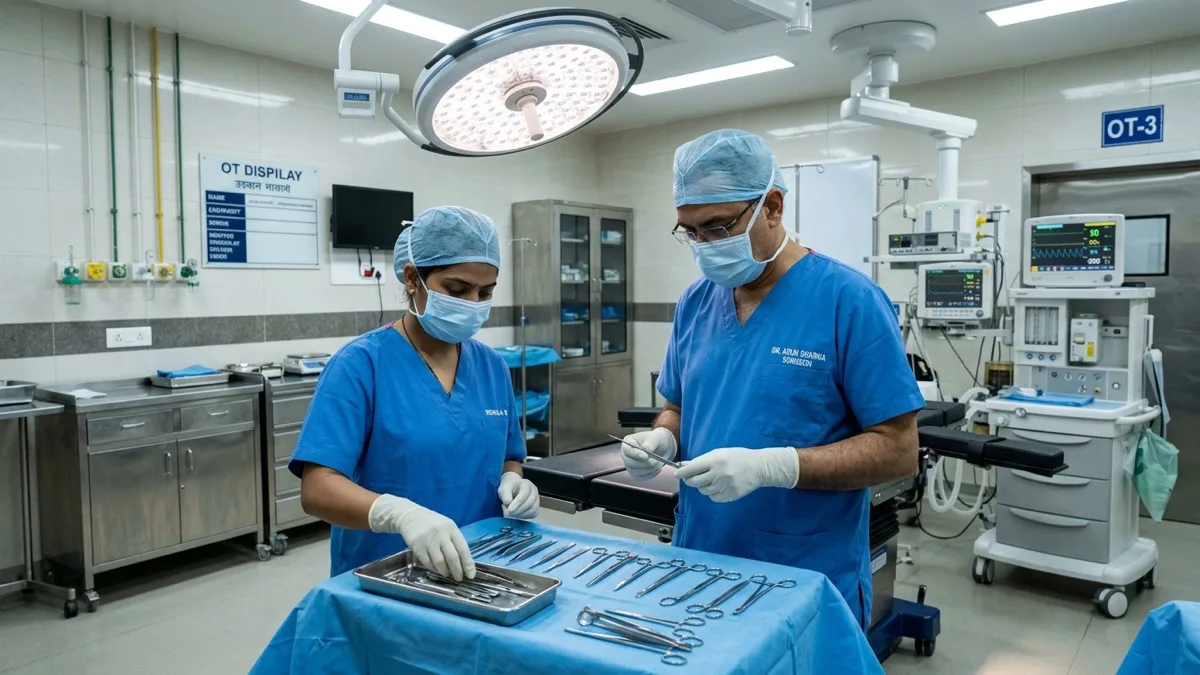
The B.Sc. in Operation Theatre Technology (OTT) at Om Sai Para Medical College (OSPMC), Ambala is a 4-year undergraduate university science degree (3 years academic coursework + 1-year clinical surgical internship). Operating at Philadelphia Mission Hospital, students are trained in perioperative surgical care, anesthesia ventilators, surgical robotics assistance, and sterile room management.
B.Sc. Operation Theatre Technology (OTT) Program Snapshot & Executive Summary
| Program Parameter | Course Specification (OSPMC Ambala) |
|---|---|
| Course Level | University Undergraduate Science Degree (4 Years Full-Time) |
| Program Duration | 4 Years (Includes active clinical hospital postings) |
| Minimum Eligibility | 10+2 Pass in Science (PCB/PCM) or recognized stream (Min. 45% aggregate) |
| Admission Mode | Direct Merit-Based Counselling (No NEET score required for 2026-27 batch) |
| Annual Tuition Fee | ₹60,000 / year (3 installments: ₹20,000 + ₹20,000 + ₹20,000) |
| Clinical Hospital Campus | Philadelphia Mission Hospital campus, Ambala City (Multi-Specialty Surgical Suites & Intensive Care Units) |
| Affiliation & Recognition | UGC Aligned / University Affiliated / State Paramedical Board Recognized |
Detailed Clinical Curriculum & Syllabus Modules
The academic syllabus at OSPMC is structured in strict alignment with national paramedical council standards, blending comprehensive classroom theory with supervised hospital clinical benchwork.
Year 1: Surgical Anatomy, Physiology, Asepsis & Surgical Principles
- Systemic Surgical Anatomy: Anatomical surgical corridors, visceral topographies, vascular triangles, and incision planes.
- Principles of Surgical Asepsis: Operating room zoning, laminar airflow systems, microbial barrier integrity, and surgical hand scrubbing.
- Basic Surgical Instrumentation: Classification, handling, sterilization, and care of general surgical instruments and cutting tools.
- Introduction to Anesthesia Science: Medical gas supply systems, cylinder manifolds, breathing circuits, and basic pharmacology of anesthetics.
Year 2: Specialized Surgical Scrubbing, Anesthesia Workstations & Critical Care
- Orthopedic & Trauma Surgery: Power drills, oscillating saws, intramedullary reaming, fracture reduction, and external fixators.
- Anesthesia Workstation Management: Automated machine self-tests, vaporizers, ventilator parameters, capnography, and gas scavenging systems.
- Laparoscopy & Minimally Invasive Surgery: Laparoscopic imaging systems, pneumoperitoneum insufflation, trocars, graspers, and harmonic scalpels.
- Cardiopulmonary Resuscitation & Emergency Care: ACLS protocols, crash cart management, emergency tracheostomy, and cardiac defibrillation in the OT.
Year 3: Super-Specialty Surgery, CSSD Leadership & Clinical Internship
- Neurosurgery & Cardiothoracic Surgery: Craniotomy sets, stereotactic frames, cardiopulmonary bypass assistance, and vascular grafting.
- Central Sterile Supply Department (CSSD) Operations: CSSD workflow automation, instrument tracking, packaging validation, and NABH compliance.
- Post-Anesthesia Care Unit (PACU) Management: Patient airway recovery, postoperative analgesia monitoring, and preventing post-anesthesia hypothermia.
- Full-Year Clinical Surgical Internship: Daily scrub postings across Philadelphia Mission Hospital Major and Emergency surgical theatres.
Hands-On Clinical Machinery & Equipment Mastered
Unlike non-clinical institutions, OSPMC students gain direct operational mastery over high-precision equipment installed at Philadelphia Mission Hospital:
- Computerized Anesthesia Workstations: Integrated anesthesia systems with automated ventilation modes and real-time volatile agent monitoring.
- Ultra-HD Laparoscopic Towers: High-definition 4K endoscopic cameras, xenon light sources, and electronic CO2 insufflators.
- Electrosurgical & Ultrasonic Generators: Advanced monopolar/bipolar electrosurgery and vessel-sealing ultrasonic instruments.
- Mobile C-Arm Fluoroscopy Imaging Units: Intraoperative radiographic imaging systems for orthopedic, vascular, and urological surgeries.
- Defibrillators & Emergency Crash Equipment: Synchronized cardioversion biphasic defibrillators and automated CPR aids.
Clinical Hospital Postings at Philadelphia Mission Hospital
The core competitive advantage of studying at OSPMC is our direct physical campus integration with Philadelphia Mission Hospital, Ambala City. Established in 2004, the hospital provides live daily case exposure:
- Year-Long Surgical Scrub Internship: Serving as primary sterile scrub technician during elective and emergency surgeries under chief surgeons.
- Anesthesia Department Rotations: Assisting consultant anesthesiologists in endotracheal intubations, spinal blocks, and invasive monitoring.
- Emergency Surgical Admissions: Rapid surgical suite preparation for emergency exploratory laparotomies and compound fractures.
Career Scope, Salary Matrix & Employment Outlook in India
Allied healthcare and paramedical technologies represent one of India's fastest-growing employment sectors. OSPMC graduates command strong starting salaries with rapid career progression:
| Designation / Role | Workplace Environment | Experience | Average Salary Scale (INR) |
|---|---|---|---|
| Surgical Technologist (B.Sc OTT) | Private Hospitals / Surgical Centers | Fresher (0–1 Year) | ₹24,000 – ₹32,000 / mo |
| Senior Scrub Technologist | Corporate Super-Specialty Hospitals | 1–3 Years | ₹32,000 – ₹45,000 / mo |
| Operating Room In-Charge / Supervisor | Tertiary Care Hospital Surgical Theatres | 3–6 Years | ₹48,000 – ₹70,000 / mo |
| Government OT Officer (AIIMS / State Health) | Central Government Medical Colleges | Exam Qualified | ₹35,400 – ₹67,000 / mo (Pay Level 6) |
| Surgical MNC Application Specialist | Medical Device Leaders (Stryker, Medtronic, Karl Storz) | 5+ Years | ₹65,000 – ₹1,20,000+ / mo |
Frequently Asked Questions (FAQs) - B.Sc. Operation Theatre Technology (OTT)
Q1: What are the key career advantages of B.Sc. OTT?
B.Sc. OTT is a 4-year university science degree qualifying graduates for senior operating room supervision, surgical MNC careers, and higher studies (M.Sc. in OT Technology or Hospital Administration).
Q2: Is NEET required for B.Sc. OTT?
No. Admission is based on 10+2 marks through direct merit counselling at OSPMC.
Q3: What is the annual tuition fee?
The annual tuition fee is ₹60,000 per year, payable in 3 installments (₹20,000 + ₹20,000 + ₹20,000). A one-time admission form fee of ₹2,000 and an examination fee of ₹2,000 per semester are charged separately.
Q4: Where will live surgical rotations take place?
All surgical postings and clinical training occur in the active operation theatres of Philadelphia Mission Hospital, Ambala City.
Q5: What higher qualifications can I pursue?
Graduates can pursue M.Sc. in Operation Theatre Technology, Master of Hospital Administration (MHA), or appear for government gazetted exams.
Direct WhatsApp Admission Helpline — B.Sc. Operation Theatre Technology (OTT)
Have questions regarding eligibility, seat availability, installment fee options, or Philadelphia Mission Hospital rotations? Connect directly with our Senior Admission Counsellor on WhatsApp for instant guidance.
Chat with Admission Team on WhatsAppEligibility
Minimum Qualification: 10+2 Pass from a recognized educational board (CBSE, HBSE, ICSE, or State Boards). Candidates with Science (PCB/PCM) with minimum 45% aggregate marks are eligible.
Age Limit: Minimum 17 years at the time of admission. Direct merit counselling open for 2026-27 batch (No NEET required).
Fees
Official Annual Tuition Fee (2026-27 Session): ₹60,000 per year
Installment Schedule (3 installments per year):
- 1st Installment: ₹20,000/-
- 2nd Installment: ₹20,000/-
- 3rd Installment: ₹20,000/-
- Grand Total Fee per Year: ₹60,000
Other Fees:
- Admission Form Fee: ₹2,000 (one time)
- Examination Fee: ₹2,000 per semester
- Hospital Practical Training: Daily clinical rotations at Philadelphia Mission Hospital campus included in the tuition fee. Zero hidden laboratory charges.