
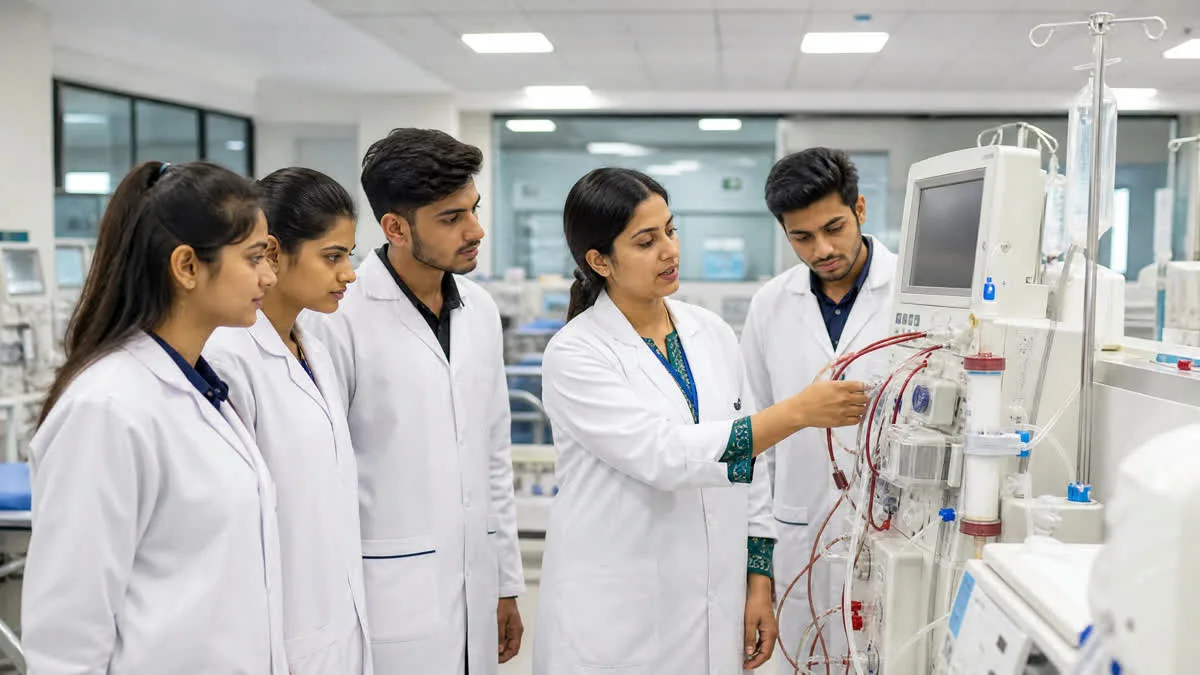
Chronic Kidney Disease (CKD) has emerged as one of the most critical public health crises in India, fueled by skyrocketing rates of diabetes and hypertension. When kidneys lose over 85% to 90% of their filtration capacity, life depends entirely on renal replacement therapy—primarily Hemodialysis. Dialysis Technologists operate the life-saving artificial kidney machines, managing blood circulation and fluid-electrolyte balance for renal patients several times every week.
Philadelphia Mission Hospital Renal Dialysis Unit • OSPMC Ambala. Below is the visual clinical protocol flowchart:
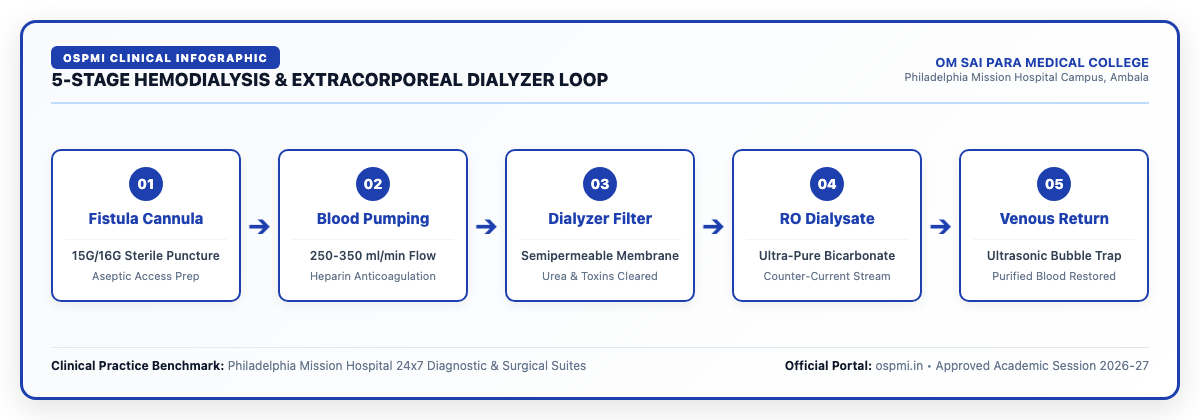
| Stage | Extracorporeal Step | Hardware & Medical Devices | Clinical Safety Target |
|---|---|---|---|
| 01. Cannulation | Sterile AV fistula puncture with arterial/venous needles | 15G/16G siliconized fistula needles | Preserve vascular access integrity (Zero hematoma) |
| 02. Pumping | Controlled blood propulsion & infusion heparinization | Fresenius peristaltic roller pump & syringe driver | Maintain targeted ACT (Activated Clotting Time 200s) |
| 03. Filtration | Diffusion of toxic nitrogenous wastes across membrane | High-flux polysulfone synthetic dialyzer filter | Kt/V clearance > 1.4 per standard 4-hr session |
| 04. Exchange | Counter-current flow of pure dialysate correcting acidosis | Double-pass RO plant & bicarbonate concentrate | AAMI compliant water (< 0.25 EU/ml endotoxin) |
| 05. Reinfusion | Safe return of purified blood through venous air trap | Ultrasonic micro-bubble detector & line clamp | 100% elimination of venous air embolism risk |
At Om Sai Para Medical College (OSPMC), Ambala, operating within the Philadelphia Mission Hospital campus since 2004, students train directly inside active nephrology and hemodialysis units under experienced nephrologists and senior dialysis technologists.
How Hemodialysis Works: The Artificial Kidney Machine
Hemodialysis is an extracorporeal blood purification procedure where blood is pumped out of the patient's vascular access, filtered across a semi-permeable synthetic membrane (the dialyzer), and returned cleansed back to the patient. Dialysis technologists master:
- Extracorporeal Circuit Priming: Connecting and priming arterial and venous blood tubing lines with sterile normal saline, eliminating microscopic air bubbles that could trigger lethal air embolisms.
- Dialyzer Physics & Clearance: Understanding hollow-fiber synthetic membranes (polysulfone and polyethersulfone), solute diffusion, convective clearance, and ultrafiltration rates (UFR).
- Dialysate Chemistry & Proportions: Formulating individualized bicarbonate and acid concentrates containing precise concentrations of sodium, potassium, calcium, magnesium, chloride, and glucose.
- Anticoagulation Protocols: Administering unfractionated heparin boluses and maintenance doses to prevent circuit clotting without risking patient hemorrhage.
Vascular Access Care: The Lifeline of Dialysis
Vascular access is famously referred to as the patient's lifeline. Technologists develop elite tactile skills in:
- Arteriovenous (AV) Fistula Cannulation: Perfecting both rope-ladder and buttonhole cannulation techniques using 15-gauge and 16-gauge specialized fistula needles.
- AV Graft & Catheter Care: Dressing temporary dual-lumen internal jugular catheters, checking for access stenosis, and executing catheter locking protocols with heparin or taurolidine.
- Intra-Dialytic Emergency Management: Rapid intervention during sudden hypotension, muscle cramps, dialysis disequilibrium syndrome, and blood leak detector alarms.
The Water Treatment Plant: Reverse Osmosis (RO) Engineering
A hemodialysis patient is exposed to 300 to 400 liters of water every week through the dialyzer membrane. Contaminated water can cause acute pyrogenic reactions and heavy metal toxicity. Dialysis technologists are rigorously trained in water treatment operations:
- Pre-Treatment Filtration: Sand filters, activated carbon beds for chlorine removal, and dual-column water softeners for calcium/magnesium removal.
- Reverse Osmosis System: High-pressure semi-permeable polyamide membranes removing dissolved solids, viruses, and bacteria.
- Endotoxin & Colony Count Surveillance: Regular microbiological sampling, LAL endotoxin testing, and chemical loop disinfection using peracetic acid or ozone.
Career Pathways & Placement Opportunities
The shortage of certified dialysis technologists in India and abroad makes this one of the most recession-proof paramedical specialties:
- Hospital Hemodialysis Technologist: Managing inpatient and emergency ICU dialysis units in multi-specialty hospitals. Starting package: ₹2.8 Lakh to ₹4.8 Lakh / year.
- Dialysis Unit Supervisor in Private Chains: Heading center operations in organized dialysis networks like NephroPlus, Fresenius Medical Care, and Apex Kidney Care.
- ICU Renal Replacement Specialist: Operating Continuous Renal Replacement Therapy (CRRT) machines in intensive care and organ transplant units.
- High-Demand Overseas Placement: Certified dialysis technologists with 2+ years of experience are rapidly recruited across GCC nations (Saudi Arabia, UAE, Qatar) and Europe with tax-free packages exceeding ₹12 Lakh to ₹20 Lakh / year.
Frequently Asked Questions (FAQs)
Q1: What are the qualifications needed to enroll in Dialysis Technology?
Students who have passed 10th or 10+2 from any recognized board can apply for the 2-Year Diploma. Students with 10+2 Science (PCB) are eligible for the 3-Year B.Voc or 4-Year B.Sc programs.
Q2: Is NEET required for Dialysis Technology admission?
No. Admissions at OSPMC Ambala are conducted directly on merit counselling without NEET.
Q3: How much live clinical experience do students get at OSPMC?
Students participate in daily hospital rotations at the Philadelphia Mission Hospital campus, assisting in real patient dialysis setups, cannulations, and machine monitoring.
Official 2026-27 Fee Structure and Installments
At Om Sai Para Medical College (OSPMC), Ambala, the annual tuition fee is payable in 3 installments every year:
• Diploma Programs (DMLT, OTT, Optometry, Dialysis, Cath Lab): ₹50,000 / year (₹15,000 + ₹17,500 + ₹17,500)
• B.Voc Degree Programs: ₹55,000 / year (₹15,000 + ₹20,000 + ₹20,000)
• B.Sc Degree Programs and BMLS: ₹60,000 / year (₹20,000 + ₹20,000 + ₹20,000)
• Admission form: ₹2,000 (one time). Examination fee: ₹1,000 per semester (Diploma, B.Voc), ₹2,000 per semester (B.Sc, BMLS)
0 comments
Be the first to comment on this article.