
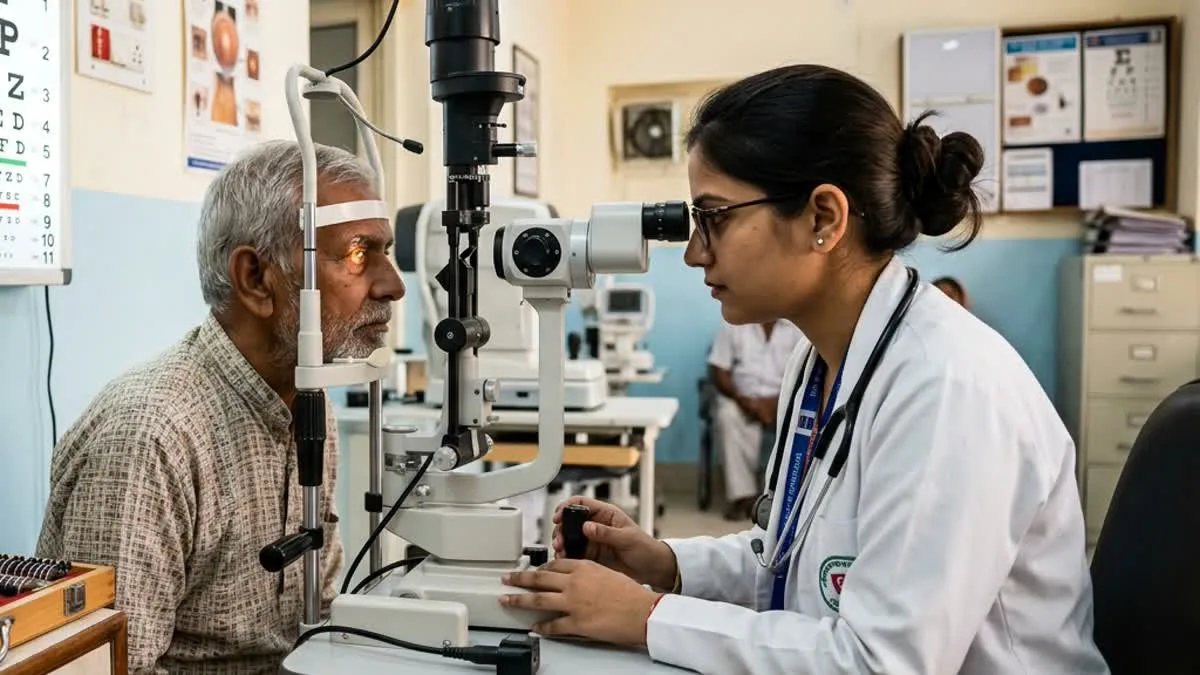
The Diploma in Optometry at Om Sai Para Medical College (OSPMI), Ambala is a dedicated 2-year clinical program that trains healthcare professionals to diagnose refractive errors, operate ophthalmic machinery, fit corrective lenses, and detect ocular diseases at the Philadelphia Mission Hospital Eye Clinic.
Diploma in Optometry Program Snapshot & Executive Summary
| Program Parameter | Course Specification (OSPMI Ambala) |
|---|---|
| Course Level | Undergraduate Paramedical Diploma (2 Years Full-Time) |
| Program Duration | 2 Years (Includes active clinical hospital postings) |
| Minimum Eligibility | 10+2 Pass in Science (PCB/PCM) or recognized stream (Min. 45% aggregate) |
| Admission Mode | Direct Merit-Based Counselling (No NEET score required for 2026-27 batch) |
| Annual Tuition Fee | ₹36,000 / year (Payable in 2 approved term installments: ₹18,000/- at admission + ₹18,000/- in November) |
| Clinical Hospital Campus | Philadelphia Mission Hospital campus, Ambala City (Ophthalmic Clinic & Vision Diagnostics Unit) |
| Affiliation & Recognition | UGC Aligned / University Affiliated / State Paramedical Board Recognized |
Detailed Clinical Curriculum & Syllabus Modules
The academic syllabus at OSPMI is structured in strict alignment with national paramedical council standards, blending comprehensive classroom theory with supervised hospital clinical benchwork.
Year 1: Ocular Anatomy, Physical Optics & Principles of Refraction
- Ocular Anatomy & Physiology: Structure of the cornea, sclera, uveal tract, lens, vitreous, retina, optic nerve, and extraocular muscles.
- Physical & Geometric Optics: Laws of refraction, reflection, spherical and astigmatic lenses, prisms, focal lengths, and vergence.
- Visual Acuity & Refraction Methods: Standard Snellen, LogMAR, tumbling E charts, pinhole visual acuity, and subjective vs objective refraction.
- Retinoscopy & Trial Frame Assembly: Streak retinoscopy technique, neutralization of spherical and cylindrical errors, working distance correction.
- Ophthalmic Pharmacology Basics: Diagnostic cycloplegics, mydriatics (Tropicamide), topical anesthetics, and artificial tears.
Year 2: Ocular Diseases, Contact Lenses & Hospital Eye Clinic Rotations
- Clinical Slit-Lamp Biomicroscopy: Direct, indirect, and retro-illumination evaluation of anterior segment, tear film, and corneal integrity.
- Contact Lens Fitting & Care: Soft spherical, toric, and rigid gas permeable (RGP) contact lens fitting, trial evaluation, and cleaning regimens.
- Ocular Diseases Screening: Recognizing cataract, glaucoma (intraocular pressure tonometry), diabetic retinopathy, and hypertensive changes.
- Ophthalmic Dispensing & Workshop: Lens neutralizing via manual and digital lensometers, frame measurements (interpupillary distance - IPD), and lens glazing.
- Hospital Eye Clinic Postings: Rotations inside Philadelphia Mission Hospital Outpatient Eye Clinic, assisting in cataract screening camps and vision diagnostics.
Hands-On Clinical Machinery & Equipment Mastered
Unlike non-clinical institutions, OSPMI students gain direct operational mastery over high-precision equipment installed at Philadelphia Mission Hospital:
- Slit-Lamp Biomicroscopes: Precision biomicroscopes with variable magnification and yellow/blue filters for anterior eye evaluation.
- Auto-Kerato Refractometers (ARK): High-speed automated optical refractors measuring corneal curvature and objective refractive power.
- Streak Retinoscopes & Trial Lens Sets: Full-aperture trial lens sets with trial frames, cross-cylinders, and Welch Allyn streak retinoscopes.
- Schiotz & Non-Contact Tonometers: Direct contact and air-puff tonometry instruments for intraocular pressure (IOP) glaucoma screening.
- Direct & Indirect Ophthalmoscopes: High-intensity halogen ophthalmoscopes for posterior fundus and optic disc examination.
Clinical Hospital Postings at Philadelphia Mission Hospital
The core competitive advantage of studying at OSPMI is our direct physical campus integration with Philadelphia Mission Hospital, Ambala City. Established in 2004, the hospital provides live daily case exposure:
- Comprehensive Refraction Clinics: Evaluating daily OPD patients for myopia, hyperopia, presbyopia, and astigmatism under senior optometrists.
- Community Eye Screening Outreach: Conducting rural school and geriatric vision screening camps organized by Philadelphia Mission Hospital.
- Pre-Op Cataract Workup: Calculating keratometry (K1/K2) readings and subjective visual potential before phacoemulsification surgery.
Career Scope, Salary Matrix & Employment Outlook in India
Allied healthcare and paramedical technologies represent one of India's fastest-growing employment sectors. OSPMI graduates command strong starting salaries with rapid career progression:
| Designation / Role | Workplace Environment | Experience | Average Salary Scale (INR) |
|---|---|---|---|
| Junior Optometrist / Refractionist | Optical Retail Chains (Lenskart, Titan Eyeplus) | Fresher (0–1 Year) | ₹18,000 – ₹25,000 / mo |
| Hospital Clinical Optometrist | Eye Care Hospitals & Ophthalmic Clinics | 1–3 Years | ₹24,000 – ₹34,000 / mo |
| Senior Contact Lens Specialist | Super-Specialty Eye Institutes | 3–6 Years | ₹35,000 – ₹48,000 / mo |
| Government Vision Technician | National Program for Control of Blindness (NPCB) | Exam Qualified | ₹28,000 – ₹48,000 / mo (Pay Level 5) |
| Optical Store Entrepreneur / Clinic Owner | Independent Practice / Optical Enterprise | 3+ Years | ₹50,000 – ₹1,00,000+ / mo |
Frequently Asked Questions (FAQs) - Diploma in Optometry
Q1: What is the role of an optometrist?
An optometrist examines eyes for refractive errors, prescribes spectacles and contact lenses, detects signs of eye diseases like glaucoma and cataracts, and provides low vision aids.
Q2: Is NEET compulsory for Diploma in Optometry?
No, NEET is not required. Admission is based on 10+2 marks through direct merit counselling at OSPMI.
Q3: What is the annual course fee?
The official annual tuition fee is ₹36,000 per year, payable in 2 equal installments of ₹18,000 at admission and ₹18,000 in November.
Q4: Can a Diploma Optometrist open an optical clinic in India?
Yes. Diploma holders can operate optical dispensing centers, vision testing clinics, and optical retail establishments.
Q5: Where do practicals take place?
Practicals and clinical rotations take place inside the Philadelphia Mission Hospital Eye Department in Ambala City.
Direct WhatsApp Admission Helpline — Diploma in Optometry
Have questions regarding eligibility, seat availability, installment fee options, or Philadelphia Mission Hospital rotations? Connect directly with our Senior Admission Counsellor on WhatsApp for instant guidance.
Chat with Admission Team on WhatsAppEligibility
Minimum Qualification: 10+2 Pass from a recognized educational board (CBSE, HBSE, ICSE, or State Boards). Candidates with Science (PCB/PCM) with minimum 45% aggregate marks are eligible.
Age Limit: Minimum 17 years at the time of admission. Direct merit counselling open for 2026-27 batch (No NEET required).
Fees
Official Annual Tuition Fee (2026-27 Session): ₹36,000 / year per year
Approved 2-Term Installment Schedule:
- 1st Installment (At the Time of Admission): ₹18,000/-
- 2nd Installment (Month of November): ₹18,000/-
- Grand Total Fee per Year: ₹36,000 / year
Institutional Fee Regulations:
- Examination & Registration Fee: Charged separately as per University and Board Norms.
- Hospital Practical Training: Daily clinical rotations at Philadelphia Mission Hospital campus included in the tuition fee. Zero hidden laboratory charges.
- Installment Deadlines: 2nd installment is strictly payable in the month of November.