
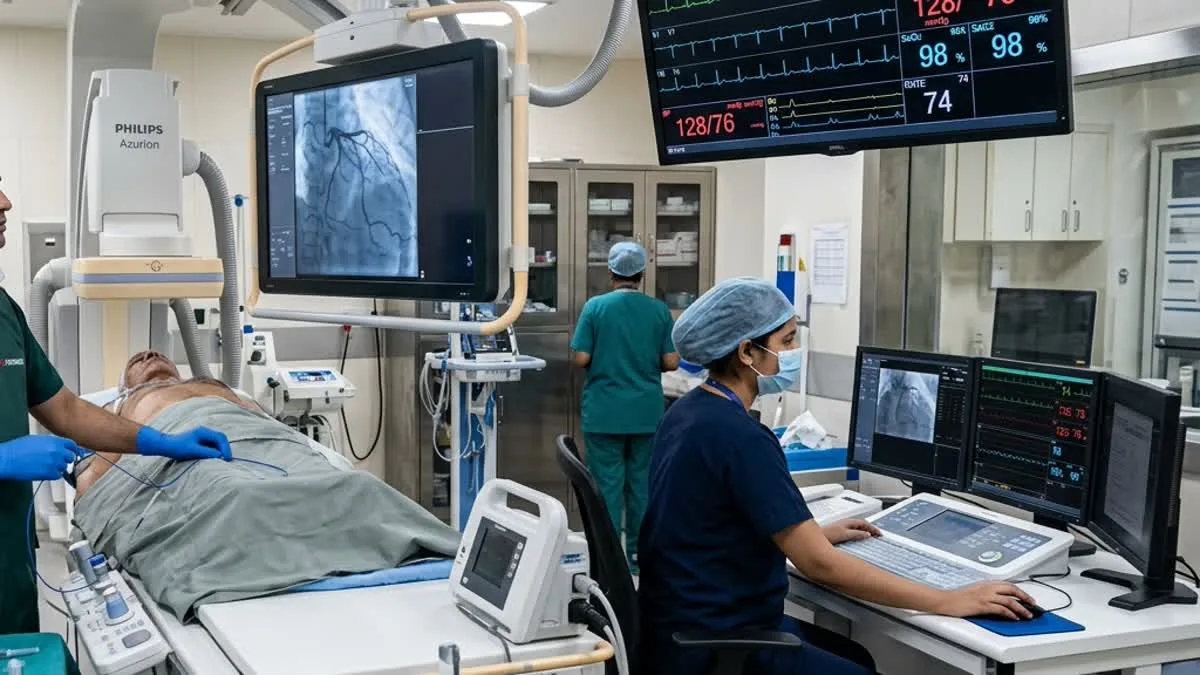
The Diploma in Cardiac Cath Lab (CCT) at Om Sai Para Medical College (OSPMC), Ambala trains students in cardiovascular anatomy, diagnostic 12-lead electrocardiography, hemodynamic vitals monitoring, and interventional catheterization laboratory assistance at Philadelphia Mission Hospital.
Diploma in Cardiac Cath Lab (CCT) Program Snapshot & Executive Summary
| Program Parameter | Course Specification (OSPMC Ambala) |
|---|---|
| Course Level | Undergraduate Paramedical Diploma (2 Years Full-Time) |
| Program Duration | 2 Years (Includes active clinical hospital postings) |
| Minimum Eligibility | 10+2 Pass in Science (PCB/PCM) or recognized stream (Min. 45% aggregate) |
| Admission Mode | Direct Merit-Based Counselling (No NEET score required for 2026-27 batch) |
| Annual Tuition Fee | ₹50,000 / year (3 installments: ₹15,000 + ₹17,500 + ₹17,500) |
| Clinical Hospital Campus | Philadelphia Mission Hospital campus, Ambala City (Cardiac Diagnostic & Cath Lab Unit) |
| Affiliation & Recognition | UGC Aligned / University Affiliated / State Paramedical Board Recognized |
Detailed Clinical Curriculum & Syllabus Modules
The academic syllabus at OSPMC is structured in strict alignment with national paramedical council standards, blending comprehensive classroom theory with supervised hospital clinical benchwork.
Year 1: Cardiovascular Anatomy, Electrophysiology & Non-Invasive Cardiology
- Cardiovascular Anatomy & Pathology: Heart chamber anatomy, coronary arteries, cardiac conduction system, valvular structure, and ischemic heart diseases.
- 12-Lead Electrocardiography (ECG): Electrode placement, Einthoven’s triangle, normal waveforms (P, QRS, T), arrhythmia identification, and myocardial infarction patterns.
- Basic Life Support & Emergency Resuscitation: AHA guidelines for CPR, automated external defibrillator (AED) operation, airway management, and emergency medications.
- Hemodynamics & Arterial Pressure: Normal blood pressure regulation, invasive vs non-invasive arterial lines, central venous pressure (CVP), and pulse oximetry.
- Cardiovascular Pharmacology: Antiplatelet agents, anticoagulants (Heparin), thrombolytic agents, beta-blockers, nitroglycerin, and atropine.
Year 2: Interventional Cath Lab Procedures, Pacemakers & Emergency Rotations
- Cardiac Catheterization Procedures: Assisting interventional cardiologists in coronary angiography (CAG), percutaneous transluminal coronary angioplasty (PTCA), and stent delivery.
- Cath Lab Hemodynamic Console Operation: Real-time pressure waveform monitoring, fractional flow reserve (FFR), translesional pressure gradients.
- Cardiac Pacemakers & Electrophysiology: Temporary pacemaker wire insertion assistance, external pacing generators, basic implantable cardioverter-defibrillator (ICD) concepts.
- Radiation Protection in Cath Lab: Lead aprons, thyroid shields, ceiling suspended lead glass, ALARA principle, and thermoluminescent dosimeter (TLD) badge monitoring.
- Hospital Clinical Postings: Rotations inside Philadelphia Mission Hospital Emergency Cardiac Care Unit, intensive coronary care, and diagnostic ECG suites.
Hands-On Clinical Machinery & Equipment Mastered
Unlike non-clinical institutions, OSPMC students gain direct operational mastery over high-precision equipment installed at Philadelphia Mission Hospital:
- Cardiac Catheterization Fluoroscopy Systems: High-resolution C-arm fluoroscopy systems for live coronary angiography navigation and digital subtraction.
- Multi-Channel Hemodynamic Monitoring Consoles: Real-time multi-lead ECG, continuous invasive arterial blood pressure, and left ventricular end-diastolic pressure displays.
- 12-Lead Digital Diagnostic ECG Recorders: High-frequency digital electrocardiographs with thermal printouts and automated rhythm analysis.
- Biphasic Defibrillators & External Pacemakers: Emergency defibrillators with synchronized cardioversion, external pacing pads, and transcutaneous pacing modules.
- Automated Contrast Power Injectors: Microprocessor-controlled high-pressure injectors delivering radiopaque dye into coronary vessels at precise flow rates.
Clinical Hospital Postings at Philadelphia Mission Hospital
The core competitive advantage of studying at OSPMC is our direct physical campus integration with Philadelphia Mission Hospital, Ambala City. Established in 2004, the hospital provides live daily case exposure:
- Emergency Stat Cardiac Evaluations: Rapid 12-lead ECG acquisition and rhythm interpretation for patients presenting with chest pain in the emergency room.
- Coronary Cath Lab Sterile Table Setup: Preparing sterile angioplasty trays, guidewires, balloon catheters, and manifold pressure transducer systems.
- Post-Procedure Puncture Site Management: Femoral and radial sheath removal, compression bandage application, and monitoring for hematoma formation.
Career Scope, Salary Matrix & Employment Outlook in India
Allied healthcare and paramedical technologies represent one of India's fastest-growing employment sectors. OSPMC graduates command strong starting salaries with rapid career progression:
| Designation / Role | Workplace Environment | Experience | Average Salary Scale (INR) |
|---|---|---|---|
| Junior Cardiac Technologist | Cardiac Diagnostic Centers / Private Hospitals | Fresher (0–1 Year) | ₹20,000 – ₹28,000 / mo |
| Cath Lab Technologist | Heart Institutes & Multi-Specialty Hospitals | 1–3 Years | ₹28,000 – ₹40,000 / mo |
| Senior Interventional Technologist | Super-Specialty Cardiac Hospitals (Fortis, Medanta) | 3–6 Years | ₹42,000 – ₹58,000 / mo |
| Govt Cardiac Technologist (AIIMS / State Health) | Central Government Medical Colleges | Exam Qualified | ₹35,400 – ₹65,000 / mo (Pay Level 6) |
| Cardiovascular Application Specialist | Medical Device Leaders (Boston Scientific, Abbott) | 5+ Years | ₹60,000 – ₹1,00,000+ / mo |
Frequently Asked Questions (FAQs) - Diploma in Cardiac Cath Lab (CCT)
Q1: What is the role of a Cardiac Cath Lab Technologist?
A Cath Lab Technologist assists cardiologists during invasive heart procedures like coronary angiography and angioplasty, manages hemodynamic monitoring consoles, prepares catheters, and ensures radiation safety.
Q2: Is NEET required for Diploma in Cardiac Cath Lab?
No. Admission is 100% merit-based according to your 10+2 marks.
Q3: What is the fee for this diploma at OSPMC?
The annual tuition fee is ₹50,000 per year, payable in 3 installments (₹15,000 + ₹17,500 + ₹17,500). A one-time admission form fee of ₹2,000 and an examination fee of ₹1,000 per semester are charged separately.
Q4: Where is the hospital training provided?
Practical training is provided directly at Philadelphia Mission Hospital campus in Ambala City.
Q5: What can I do after completing this diploma?
You can work as a Cardiac Technologist in cardiac centers or pursue B.Voc / B.Sc in Cardiac Care Technology via lateral entry.
Direct WhatsApp Admission Helpline — Diploma in Cardiac Cath Lab (CCT)
Have questions regarding eligibility, seat availability, installment fee options, or Philadelphia Mission Hospital rotations? Connect directly with our Senior Admission Counsellor on WhatsApp for instant guidance.
Chat with Admission Team on WhatsAppEligibility
Minimum Qualification: 10+2 Pass from a recognized educational board (CBSE, HBSE, ICSE, or State Boards). Candidates with Science (PCB/PCM) with minimum 45% aggregate marks are eligible.
Age Limit: Minimum 17 years at the time of admission. Direct merit counselling open for 2026-27 batch (No NEET required).
Fees
Official Annual Tuition Fee (2026-27 Session): ₹50,000 per year
Installment Schedule (3 installments per year):
- 1st Installment: ₹15,000/-
- 2nd Installment: ₹17,500/-
- 3rd Installment: ₹17,500/-
- Grand Total Fee per Year: ₹50,000
Other Fees:
- Admission Form Fee: ₹2,000 (one time)
- Examination Fee: ₹1,000 per semester
- Hospital Practical Training: Daily clinical rotations at Philadelphia Mission Hospital campus included in the tuition fee. Zero hidden laboratory charges.