
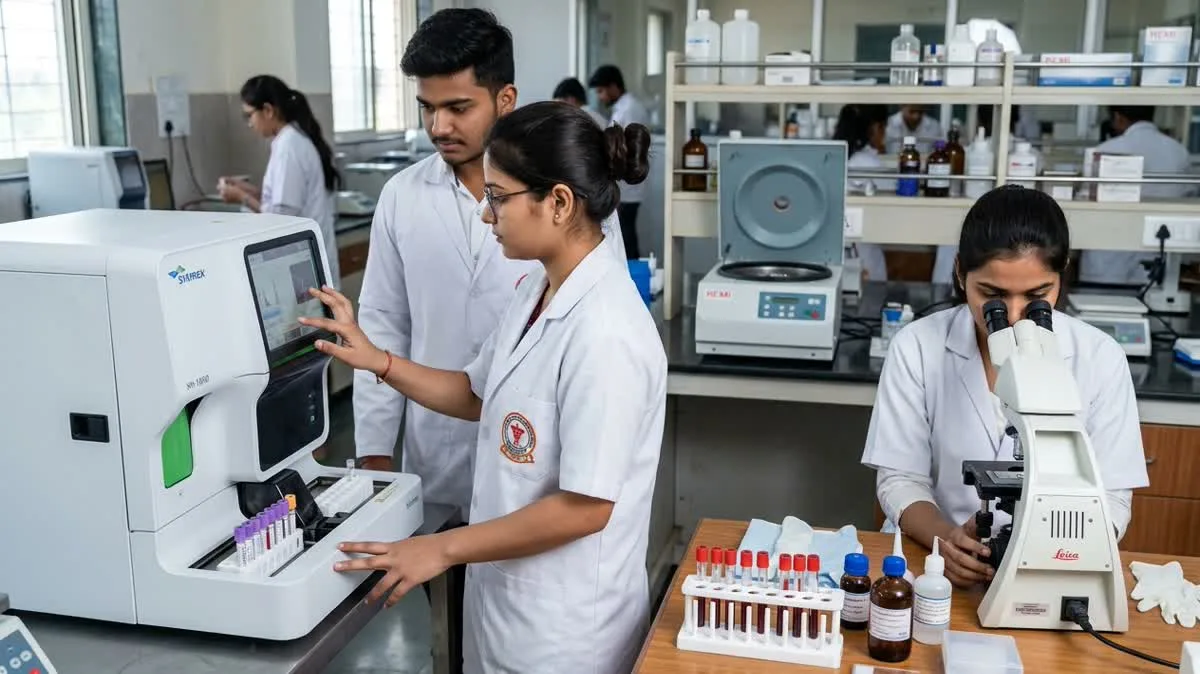
Updated: October 2026 · Session 2026-27 · Fees as per the official OSPMC fee circular
Want to work in healthcare without spending years preparing for medical entrance exams? The Diploma in Medical Laboratory Technology (DMLT) is one of the quickest and most affordable ways to do it. In two years you learn to run the tests that doctors rely on for almost every diagnosis: blood counts, sugar and kidney tests, infection tests, blood grouping and much more. This guide covers everything about DMLT admission 2026: the full form, eligibility, exact fees, the two-year syllabus, practical training, jobs, higher studies and how to apply at OM SAI PARA MEDICAL COLLEGE (OSPMC), Ambala.
Quick Answer
DMLT means Diploma in Medical Laboratory Technology. At OSPMC Ambala it is a 2-year course open to 10+2 pass students of any stream with 45% marks (Science preferred), with no NEET. The 2026-27 tuition fee is ₹50,000 per year, paid in 3 installments (₹15,000 + ₹17,500 + ₹17,500), with practical training on the Philadelphia Mission Hospital campus.
DMLT at OSPMC Ambala: Course at a Glance (2026-27)
| Detail | DMLT at OSPMC Ambala |
|---|---|
| Full form | Diploma in Medical Laboratory Technology |
| Duration | 2 years |
| Eligibility | 10+2 pass from a recognised board, any stream (Science preferred), minimum 45% aggregate |
| Minimum age | 17 years at the time of admission |
| NEET required? | No. Direct merit-based counselling |
| Tuition fee | ₹50,000 per year (3 installments: ₹15,000 + ₹17,500 + ₹17,500) |
| Total tuition | ₹1,00,000 for the full 2-year course |
| Other fees | Admission form ₹2,000 (one time) · Examination fee ₹1,000 per semester |
| Practical training | Philadelphia Mission Hospital campus, Arya Chowk, Ambala City |
| Course page | Diploma in Medical Lab Technology (DMLT) |
| Admission helpline | 90341-93228 · 80594-10073 · 72069-84438 |
What Is DMLT? Full Form and Meaning
The full form of DMLT is Diploma in Medical Laboratory Technology. It is a job-oriented paramedical diploma that teaches you how to collect, process and test biological samples such as blood, urine, sputum and other body fluids, and how to prepare tissue samples for examination.
Think of the laboratory as the place where a doctor's questions get answered. Is the patient anaemic? Is the blood sugar under control? Are the kidneys and liver working properly? Is there an infection, and which medicine will work against it? Which blood group does the patient need? A trained laboratory technician produces the reports that answer these questions, and doctors use those reports to decide the treatment.
That is why medical laboratory technology is one of the most stable fields in healthcare. Every hospital, nursing home, diagnostic centre and blood bank needs people who can run tests accurately and safely.
What Does a Lab Technician Actually Do? The Journey of a Sample
Most students choose DMLT without knowing what the daily work looks like. Here is what happens to a single blood sample, step by step. As a DMLT student you practise each of these stages.
- Collection: the patient is identified, the correct tube is chosen for the test (different tests need different tubes and additives) and blood is drawn safely. This skill is called phlebotomy.
- Labelling and transport: every tube is labelled immediately so that it can never be mixed up, and is sent to the right section of the lab.
- Processing: samples are centrifuged to separate serum or plasma where needed, and smears are prepared and stained for the microscope.
- Testing: tests are run on automated analysers or by manual methods, and quality control checks confirm that the machine and reagents are giving correct results.
- Checking: unusual results are re-checked, smears are examined under the microscope and the results are reviewed before release.
- Reporting: the final report goes to the doctor, and urgent abnormal values are communicated quickly so that the patient can be treated in time.
If you enjoy careful, hands-on work where accuracy really matters, you will find this work satisfying.
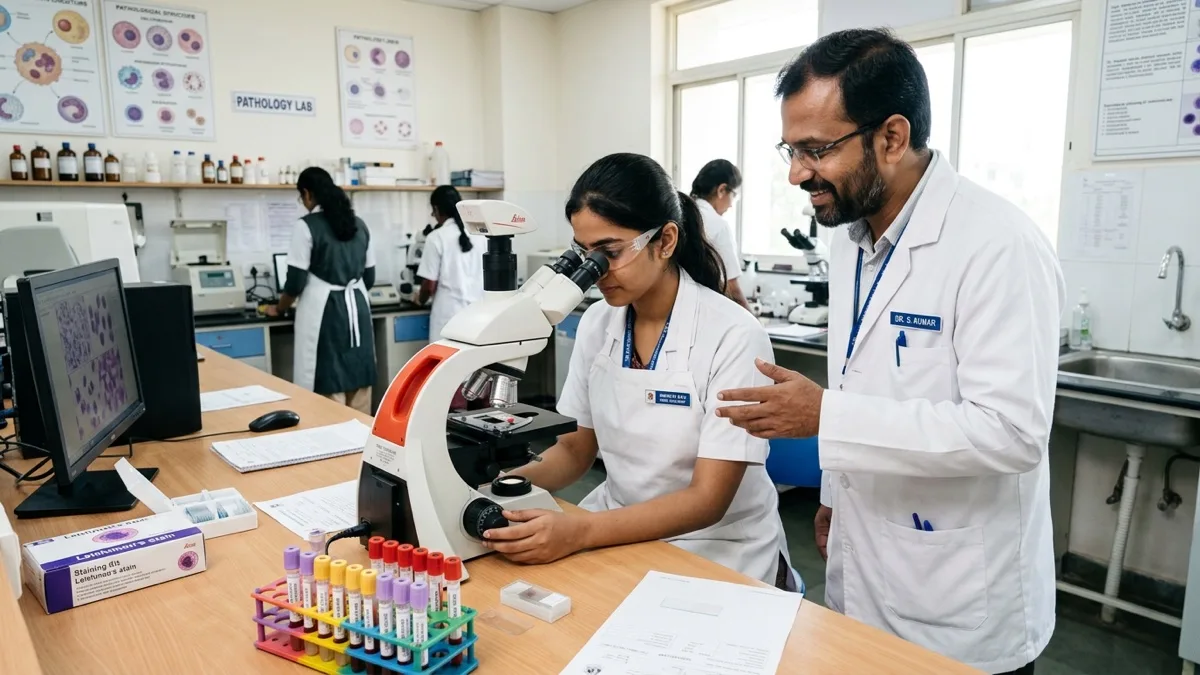
DMLT students during laboratory practical training at OSPMC, Ambala.
Why Choose DMLT After 12th? 7 Practical Reasons
- Short duration: two years, so you can start working sooner than with most degrees.
- Low total cost: ₹1,00,000 tuition for the full course at OSPMC, paid in installments.
- No entrance exam: admission is on the basis of your 10+2 result, with no NEET.
- Open to all streams: at OSPMC, DMLT accepts 10+2 students from any stream, with Science preferred.
- Steady demand: diagnostic testing is needed in every hospital, clinic and diagnostic centre.
- Many workplaces: hospital labs, pathology and diagnostic centres, blood banks and research labs.
- Room to grow: you can go on to B.Voc MLT, B.Sc MLT or BMLS later.
Is DMLT Right for You? A 6-Question Self-Check
Answer these honestly. If most of your answers are "yes", DMLT is likely a good fit.
- Do you enjoy science practicals more than memorising theory?
- Are you comfortable seeing blood and handling samples with gloves and care?
- Do you like working step by step and double-checking your work?
- Would you prefer a two-year course so that you can start working sooner?
- Are you open to shift-based work, since hospital laboratories often run day and night?
- Would you like the option to upgrade to a degree such as B.Voc MLT, B.Sc MLT or BMLS later?
If you prefer direct bedside care, a nursing course may suit you better. If you are drawn to the operation theatre, imaging or eye care instead, compare the other courses in our Haryana paramedical courses guide before deciding.
DMLT Eligibility 2026: Who Can Apply?
The DMLT eligibility at OSPMC Ambala is simple:
- Qualification: 10+2 pass from a recognised board such as CBSE, HBSE, ICSE or a state board.
- Marks: minimum 45% aggregate in 10+2.
- Stream: any stream is accepted. Science (PCB or PCM) is preferred.
- Age: minimum 17 years at the time of admission.
- Entrance exam: not required. NEET is not part of the eligibility.
Can Arts or Commerce students do DMLT?
Yes. OSPMC accepts 10+2 students from any stream for DMLT. If you did not study biology or chemistry in school, expect the first few months to need extra effort with subjects like biochemistry and microbiology. Teachers start from the basics, and regular practice in the lab helps a lot.
Can I do DMLT after 10th?
Not at OSPMC. The minimum qualification for DMLT here is 10+2. If you are in Class 11 or 12 right now, complete your 10+2 first and then apply for the next session.
DMLT Admission Process 2026-27 at OSPMC (Without NEET)
- Counselling: call 90341-93228 or message the admission team on WhatsApp. They will check your eligibility and answer questions about the course.
- Application: apply online or offline, or visit the campus at Philadelphia Mission Hospital, Arya Chowk, Ambala City.
- Documents: keep your 10th and 12th mark sheets, an ID proof and passport-size photographs ready. The admission team will confirm the complete list.
- Verification: your documents and eligibility are verified and your seat is confirmed.
- First installment: pay the first installment of ₹15,000 at the college or online to secure your seat.
Tip: apply as soon as your 10+2 result is out. Early applicants get more time for counselling and a better chance of getting the session and seat they want.
DMLT Fees 2026-27 at OSPMC Ambala
The DMLT fee at OSPMC for the 2026-27 session is ₹50,000 per year, paid in 3 installments every year.
| Fee item | Amount |
|---|---|
| Each year, 1st installment | ₹15,000 |
| Each year, 2nd installment | ₹17,500 |
| Each year, 3rd installment | ₹17,500 |
| Total tuition for 2 years | ₹1,00,000 |
| Admission form fee | ₹2,000 (one time) |
| Examination fee | ₹1,000 per semester |
DMLT fee compared with lab degrees at OSPMC
- DMLT (2 years): ₹50,000 per year, ₹1,00,000 total tuition.
- B.Voc MLT (3 years): ₹55,000 per year, ₹1,65,000 total tuition.
- B.Sc MLT (4 years): ₹60,000 per year, ₹2,40,000 total tuition.
- BMLS (3.5 years): ₹60,000 per year.
See all courses on the Fee Structure page.
DMLT Syllabus: What You Study in Year 1 and Year 2
The DMLT course balances theory with a large amount of practical laboratory work. Here are the key subjects and skills covered over the two years.
Year 1: Foundations
Theory subjects
- Human anatomy and physiology: how the body's systems work, so that test results make sense.
- Basic biochemistry: solutions, buffers, carbohydrates, proteins, fats and enzymes.
- Basic haematology: blood cells, haemoglobin, platelets and how blood clots.
- General microbiology: bacteria and other microbes, sterilisation, disinfection and culture media.
- Laboratory safety: protective equipment, safe handling of samples and biomedical waste segregation.
Practical skills
- Blood collection (phlebotomy) and correct sample labelling
- Haemoglobin estimation and blood cell counting
- Preparing and staining blood smears and examining them under the microscope
- ESR (erythrocyte sedimentation rate)
- Routine urine examination: physical, chemical and microscopic
Year 2: Advanced Diagnostics
Theory subjects
- Clinical biochemistry: liver function, kidney function, blood sugar and lipid tests.
- Clinical microbiology: identifying the bacteria and fungi that cause common infections.
- Blood banking: ABO and Rh blood grouping, cross-matching and safe transfusion.
- Histopathology and cytology: processing tissue samples and preparing slides.
- Laboratory quality: quality control, standard operating procedures and record keeping.
Practical skills
- Running biochemistry tests on analysers (for example liver and kidney function tests)
- Gram staining and acid-fast staining
- Culture on different media and antibiotic sensitivity testing
- Blood grouping and cross-matching
- Tissue sectioning and staining
- Rapid and ELISA-based tests for infections
For the detailed course structure, see the DMLT course page.
DMLT Subjects Explained in Simple Words
The subject names can sound heavy at first. Here is what each one actually means and the kind of test it leads to.
Haematology (the study of blood)
You learn about red cells, white cells and platelets, and how to count and examine them. A drop in haemoglobin can point to anaemia, a high white cell count can point to infection, and a low platelet count is closely watched in fevers such as dengue. The complete blood count is one of the most common tests in any hospital, and it starts here.
Clinical biochemistry (the chemistry of the body)
Blood carries sugar, fats, proteins, enzymes and waste products. Measuring them shows how well organs are working. Blood sugar tests help manage diabetes, liver function tests check the liver, kidney function tests check the kidneys and the lipid profile looks at cholesterol. Much of this work is done on automated analysers, so you also learn calibration and quality control.
Microbiology (the study of germs)
You learn how bacteria and fungi are identified. Samples are grown on culture media, stained and examined, and then tested against antibiotics to find which medicine will work. This antibiotic sensitivity report helps doctors treat infections correctly instead of guessing.
Blood banking (safe transfusion)
A transfusion is safe only when the blood matches the patient. You learn ABO and Rh blood grouping, cross-matching between donor and patient blood, and the safe storage and handling of blood and its components. Accuracy here directly protects lives.
Histopathology and cytology (tissues and cells)
When a doctor removes a small piece of tissue, it must be preserved, processed, cut into very thin sections and stained so that a pathologist can examine it. Cytology does the same for cells, for example in a Pap smear. You learn the preparation steps that make an accurate diagnosis possible.
Clinical pathology (urine and body fluids)
Routine urine examination is one of the simplest yet most useful tests. You learn to check its physical properties, test it chemically with strips and examine it under the microscope for cells, crystals and infection. The same approach is used for other body fluids.
10 Common Tests a DMLT Technician Performs
These are some of the tests you will practise again and again, along with what each one tells the doctor:
- Complete Blood Count (CBC): haemoglobin, red cells, white cells and platelets.
- ESR: a simple marker that rises in inflammation and some infections.
- Blood sugar (fasting, post-meal and random): for detecting and managing diabetes.
- Liver Function Test (LFT): enzymes, bilirubin and proteins that show liver health.
- Kidney Function Test (KFT): urea and creatinine that show how well the kidneys filter.
- Lipid profile: cholesterol and triglycerides linked to heart health.
- Urine routine examination: infection, sugar, protein and kidney problems.
- Blood grouping and cross-matching: for safe transfusions and surgeries.
- Culture and sensitivity: identifies the germ causing an infection and the right antibiotic.
- Rapid tests for infections: quick card or ELISA tests used for infections such as malaria, dengue and hepatitis.
What a Day Looks Like for a DMLT Student
A typical DMLT day mixes three kinds of learning. Theory classes explain why a test is done and what its result means. Practical sessions in the college laboratory let you repeat techniques such as blood collection, staining, microscopy and test procedures until they become second nature. Hospital-linked exposure on the Philadelphia Mission Hospital campus shows you how the same work is done for real patients, with real time pressure and strict record keeping.
Expect regular practical records, viva questions and practical exams. These are not formalities: they train you to explain your work clearly, which is exactly what employers check in interviews.
Laboratory Equipment You Learn to Use
Employers look for technicians who are comfortable with real equipment from day one. During DMLT you learn the working, handling and basic care of:
- Microscopes: for blood smears, urine deposits and stained bacteria.
- Centrifuges: to separate serum and plasma from blood.
- Haematology cell counters: for complete blood counts.
- Biochemistry analysers: for sugar, liver, kidney and lipid tests.
- ELISA readers and washers: for infection and hormone tests.
- Incubators and autoclaves: for growing cultures and sterilising equipment.
- Microtomes: for cutting thin tissue sections for slides.
Hospital Training at the Philadelphia Mission Hospital Campus
The biggest difference between a good and an average DMLT course is how much real practice you get. OSPMC has been running since 2004 on the Philadelphia Mission Hospital campus at Arya Chowk, Ambala City. Being on a hospital campus means you see how a working laboratory runs: real samples, real urgency and real responsibility, alongside your college practicals.
Hospital-linked training also teaches the habits that employers value: identifying patients correctly, labelling every sample, following safety rules, keeping records and communicating clearly with doctors and nurses.
Jobs and Career Scope After DMLT
After DMLT you can apply for roles such as:
- Laboratory technician: running routine tests in a hospital or diagnostic lab.
- Phlebotomist: collecting blood samples in hospitals, labs and home-collection services.
- Blood bank technician: blood grouping, cross-matching and handling blood components.
- Laboratory assistant: supporting pathologists and senior technologists.
- Sample collection centre staff: managing collection and dispatch of samples.
Where you can work: government and private hospitals, nursing homes, pathology and diagnostic centres, blood banks and research laboratories. State and central health departments also recruit laboratory technicians from time to time; always check the eligibility given in each official notification.
About salary: pay depends on the city, the employer, your skills and your experience, so be careful of any course that promises a fixed salary. Ask the counsellors for recent placement examples for DMLT students so you can judge for yourself.
Higher Studies After DMLT
DMLT does not have to be the end of your studies. Many students work for a while and then upgrade:
- B.Voc MLT: a 3-year skill-focused degree in the same field.
- B.Sc MLT: a 4-year degree with deeper theory.
- BMLS: Bachelor of Medical Laboratory Science, 3.5 years.
- Lateral entry: the OSPMC fee circular lists lateral entry into B.Voc and B.Sc. Ask the admission team whether your DMLT qualifies you to join directly in a later year.
- After a degree: postgraduate study in subjects such as medical laboratory technology, clinical biochemistry or microbiology.
DMLT vs B.Voc MLT vs B.Sc MLT vs BMLS: Which Should You Choose?
All four lead to laboratory careers. Use these points to decide:
DMLT: 2 years, ₹50,000 per year
- Fastest route to a technician job and the lowest total cost.
- Strong focus on practical lab skills.
- Best if you want to start earning soon and upgrade later.
B.Voc MLT: 3 years, ₹55,000 per year
- A degree with a practical, job-oriented focus.
- More training time than DMLT without committing to four years.
B.Sc MLT: 4 years, ₹60,000 per year
- The deepest subject knowledge of the four.
- A strong base for senior and supervisory roles and postgraduate study.
BMLS: 3.5 years, ₹60,000 per year
- A bachelor's degree in medical laboratory science.
- Confirm the current fee with the admission team.
What about DMLT vs GNM nursing?
They are different careers. DMLT trains you to work in the laboratory with samples and equipment. GNM is a nursing course focused on direct bedside patient care in wards. Choose DMLT if you prefer lab work and testing; choose nursing if you want to care for patients directly.
Skills That Make a Great Lab Technician
- Attention to detail: one wrong label or reading can change a diagnosis.
- Steady hands: for blood collection, pipetting and slide preparation.
- Following procedures: labs run on standard steps and quality checks.
- Safety habits: gloves, safe disposal of sharps and correct waste segregation.
- Calm under pressure: emergency samples need fast and accurate results.
- Good communication: with patients during collection and with doctors about urgent results.
None of these need to be perfect on day one. The two years of DMLT practice are designed to build them.
5 Mistakes to Avoid When Choosing a DMLT College
- Ignoring practical access: ask where and how often you will practise on real equipment and samples.
- Not getting the full fee in writing: confirm tuition per year, installment dates, and examination and registration fees.
- Not checking the awarding body: ask which board or university will award your diploma.
- Believing salary or placement promises without proof: ask for real, recent examples instead.
- Skipping the campus visit: see the labs and talk to the faculty before you decide.
As per the OSPMC fee circular, diplomas are awarded by IIPMT Punjab and IPH&H New Delhi. Fees are published course by course with a 3-installment schedule, and you can visit the campus before you apply.
How to Prepare Before Your DMLT Classes Start
- Revise Class 11-12 biology basics: cells, blood and the main body systems. It makes the first semester much easier.
- Brush up on simple chemistry: units, solutions and percentages are used every day in the lab.
- Learn the common test names: read the list above and try to remember what each test checks.
- Build a habit of neat record keeping: labs depend on clear labels and written records.
- Ask questions early: talk to the admission team and faculty about anything you are unsure of before the session begins.
DMLT for Students from Nearby Cities
Ambala is well connected to Karnal, Kurukshetra, Yamunanagar, Panchkula, Chandigarh, Mohali and Patiala by rail and road, and Ambala Cantt is one of the major railway junctions of North India. Read our guide to paramedical courses after 12th in Haryana for city-wise travel details and a comparison of all 22 courses at OSPMC.
DMLT FAQs
What is the full form of DMLT?
DMLT stands for Diploma in Medical Laboratory Technology. It is a 2-year paramedical diploma that trains you to test blood, urine and other samples in a medical laboratory so that doctors can diagnose and monitor disease.
What is the DMLT course duration?
DMLT at OSPMC Ambala is a 2-year course. It combines classroom teaching with practical laboratory work and hospital-linked training on the Philadelphia Mission Hospital campus.
What is the DMLT fee at OSPMC Ambala for 2026-27?
The DMLT tuition fee is ₹50,000 per year, paid in 3 installments of ₹15,000, ₹17,500 and ₹17,500. Total tuition for the 2-year course is ₹1,00,000. A one-time admission form fee of ₹2,000 and an examination fee of ₹1,000 per semester are extra.
Is NEET required for DMLT admission?
No. DMLT admission at OSPMC Ambala is through direct merit-based counselling on the basis of your 10+2 result. A NEET score is not required.
Can I do DMLT after 12th Arts or Commerce?
Yes. At OSPMC, DMLT accepts 10+2 pass candidates from any stream with at least 45% aggregate marks. Science (PCB or PCM) is preferred because it makes subjects like biochemistry and microbiology easier to follow.
Can I do DMLT after 10th?
Not at OSPMC. The DMLT eligibility at OSPMC Ambala is 10+2 pass with at least 45% aggregate marks and a minimum age of 17 years.
What is the difference between DMLT and B.Sc MLT?
DMLT is a 2-year diploma focused on practical laboratory work and gets you job-ready fastest. B.Sc MLT at OSPMC is a 4-year degree with deeper theory and a stronger base for senior roles and higher studies. DMLT costs ₹50,000 per year; B.Sc MLT costs ₹60,000 per year.
What jobs can I get after DMLT?
DMLT holders work as laboratory technicians, phlebotomists (sample collection), blood bank technicians and laboratory assistants in hospital laboratories, diagnostic and pathology centres, blood banks and research laboratories.
What can I study after DMLT?
After DMLT you can move to a degree such as B.Voc MLT, B.Sc MLT or BMLS. The OSPMC fee circular also lists lateral entry into B.Voc and B.Sc, so ask the admission team whether your diploma qualifies you to join directly in a later year.
Where will I do my DMLT practical training?
OSPMC runs on the Philadelphia Mission Hospital campus at Arya Chowk, Ambala City. DMLT students get hospital-linked practical exposure, including the pathology laboratory, in addition to their college lab practicals.
Can I pay the DMLT fee in installments?
Yes. Each year's fee of ₹50,000 is split into 3 installments: ₹15,000, ₹17,500 and ₹17,500.
How do I apply for DMLT at OSPMC Ambala?
Call or WhatsApp 90341-93228 for counselling, apply online or offline through the college website, submit your documents and pay the first installment of ₹15,000 to confirm your seat. The admission team will confirm the document list and seat availability.
DMLT Admissions Open for 2026-27
Have questions about eligibility, the installment schedule or practical training? Talk to the OSPMC admission team on WhatsApp or call 90341-93228, 80594-10073 or 72069-84438.
Chat with Admission Team on WhatsApp
0 comments
Be the first to comment on this article.