
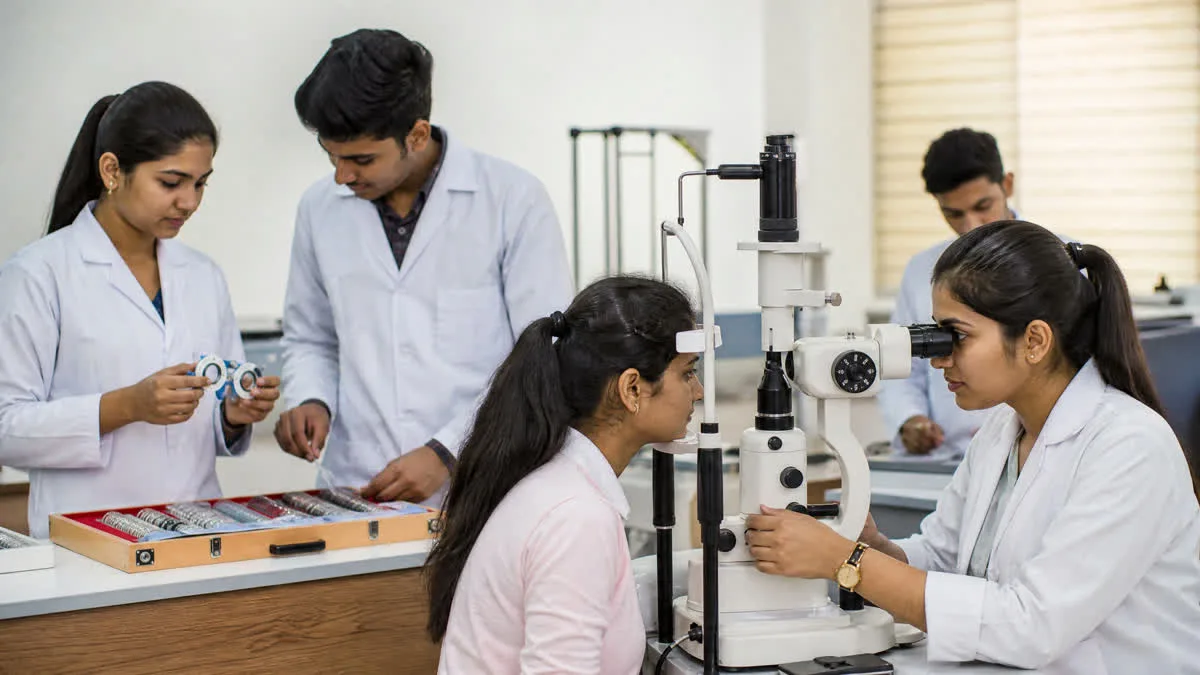
Vision is humankind's most dominant sense, accounting for more than 80% of all sensory impressions perceived by the human brain. In an era dominated by ubiquitous digital screens, lifestyle-induced diabetes, and aging populations, the global burden of refractive errors, presbyopia, and ocular diseases has reached unprecedented levels. Optometrists and Primary Vision Care Specialists stand as the frontline guardians of public ocular health.
Philadelphia Mission Hospital Eye Clinic • OSPMI Ambala. Below is the visual clinical protocol flowchart:
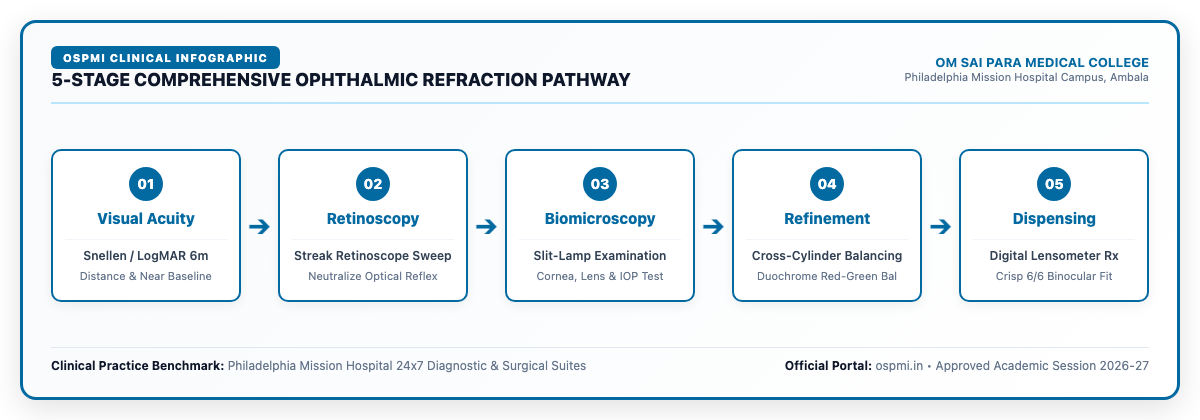
| Stage | Examination Step | Diagnostic Instruments | Clinical Goal |
|---|---|---|---|
| 01. Visual Acuity | Distance and near baseline vision assessment | Digital Snellen, LogMAR chart, Jaeger card | Distinguish refractive from pathological vision loss |
| 02. Objective Test | Objective determination of spherical and cylindrical power | Welch Allyn Streak Retinoscope & Auto-Refractometer | Accurate baseline optical neutralization |
| 03. Ocular Health | Anterior segment evaluation, tear film, IOP tonometry | Slit-Lamp Biomicroscope & Non-Contact Tonometer | Rule out glaucoma, cataract, and corneal dystrophies |
| 04. Refinement | Fine axis verification & binocular red-green balance | Trial frame, Jackson cross-cylinder, Duochrome filter | Eliminate accommodative eyestrain |
| 05. Prescription | Accurate optical power delivery & contact lens guidance | Digital lensometer & pupilometer (IPD gauge) | Deliver crisp, comfortable 6/6 bilateral vision |
Operating inside the historic Philadelphia Mission Hospital campus in Ambala City since 2004, Om Sai Para Medical College (OSPMI) delivers comprehensive clinical optometry training that bridges geometrical visual optics with hands-on patient refraction clinics.
What Does an Optometrist Do? Scope & Clinical Responsibilities
An Optometrist is an independent primary healthcare practitioner of the eye and visual system. Their clinical responsibilities extend far beyond prescribing eyeglasses:
- Comprehensive Refractive Assessment: Objective retinoscopy, auto-refractometry, subjective trial frame balancing, and astigmatic fan testing.
- Anterior Segment Biomicroscopy: Utilizing slit-lamp bio-microscopes to detect corneal abrasions, foreign bodies, pterygium, dry eye syndromes, and early cataractous changes.
- Intraocular Pressure (IOP) Tonometry: Screening for glaucoma using non-contact tonometers (NCT) and Goldman applanation tonometry.
- Contact Lens Fitting & Management: Custom fitting soft spherical, toric, rigid gas-permeable (RGP), and scleral lenses for keratoconus.
- Low Vision Rehabilitation: Prescribing telescopic and microscopic optical aids for visually impaired patients with non-correctable vision loss.
- Binocular Vision & Orthoptics: Diagnosing convergence insufficiency, phorias, and amblyopia, followed by individualized vision therapy.
Academic Qualifications in Optometry: Diploma vs B.Voc vs B.Sc
Depending on your career aspirations, three well-defined educational routes exist:
- Diploma in Optometry (2 Years): A practical, skill-focused qualification covering trial lens refraction, keratometry, lens surfacing, and retail optical dispensing. Perfect for swift entry as a clinic refractionist or optical retail store manager.
- B.Voc in Optometry Technology (3 Years): A UGC-recognized skill degree featuring 60% on-the-job clinical rotations inside hospital eye OPDs and community vision screening camps. Offers progressive exit points (Diploma after Year 1, Advanced Diploma after Year 2, Degree after Year 3).
- B.Sc. in Optometry (4 Years): A 4-year professional undergraduate degree comprising 3 years of classroom and clinical instruction followed by 1 full year of compulsory rotational clinical internship. Qualifies practitioners for master's programs (M.Optom), hospital consultancy, and research roles.
Clinical Equipment Handled During Practical Training
At OSPMI Ambala, students train on standard ophthalmic diagnostic instrumentation:
- Streak Retinoscopes & Trial Lens Sets: Mastering manual neutralization of hyperopia, myopia, and astigmatism.
- Slit-Lamp Biomicroscopes: Diffuse, direct focal, and retro-illumination techniques for corneal and anterior chamber evaluation.
- Manual & Automated Lensometers: Precise measurement of sphere, cylinder, axis, and optical center placement for progressive addition lenses (PAL).
- Keratometers & Autoref-Keratometers: Corneal curvature measurements essential for intraocular lens (IOL) power calculation and contact lens fitting.
- Phoropters & Chart Projectors: High-efficiency subjective refraction testing.
Career Opportunities & Industry Demand
The optometry industry is witnessing explosive commercial and institutional expansion:
- Corporate Optical Retail Networks: High-demand managerial and optometrist roles in optical giants like Lenskart, Titan Eyeplus, Lawrence & Mayo, and Specsavers with packages starting from ₹3.5 Lakh to ₹6 Lakh / year.
- Tertiary Eye Care Hospitals: Pre-operative and post-operative diagnostic roles in institutions like Sharp Sight, Centre for Sight, Dr. Shroff's Charity Eye Hospital, and Civil Eye Wards.
- Independent Entrepreneurship: Setting up an independent optometry clinic and optical dispensary requires modest capital and yields rapid recurring profitability.
- Overseas Practice: Strong demand across the Middle East (Dubai, Abu Dhabi, Saudi Arabia) and the Commonwealth nations for certified optometrists.
Frequently Asked Questions (FAQs)
Q1: What is the difference between an Optometrist and an Ophthalmologist?
An Ophthalmologist is a medical doctor (MBBS + MS) who performs eye surgeries and treats severe ocular pathologies. An Optometrist is a primary eye care specialist who diagnoses refractive errors, detects diseases, prescribes lenses, and manages non-surgical vision therapy.
Q2: Can I get admission in Optometry without NEET?
Yes! Admissions to Diploma, B.Voc, and B.Sc Optometry programs at OSPMI Ambala are 100% direct and merit-based on your 10+2 performance.
Q3: How much practical hospital training is provided at OSPMI?
OSPMI students undergo everyday clinical rotations inside the active eye OPD of Philadelphia Mission Hospital, examining real walk-in patients under the guidance of consultant optometrists.
Official 2026-27 Approved Fee Schedule & 2-Term Installments
At Om Sai Para Medical College (OSPMI), Ambala, annual tuition fees are approved by the governing council with transparent 2-term installment facilities (1st Term at Admission, 2nd Term in November):
• 2-Year Diplomas (DMLT, OTT, Optometry, Dialysis, Cath Lab): ₹36,000 / year (₹18,000 + ₹18,000)
• Degree Programs (B.Voc / B.Sc in MLT, OTT, Dialysis, CSSD, Patient Care, Mgmt, Nutrition): ₹46,000 / year (₹23,000 + ₹23,000)
• Degree Programs (Optometry & Radiology RMIT): ₹50,000 / year (₹25,000 + ₹25,000)
• Degree Programs (Cardiac Care Technology - CCT): ₹60,000 / year (₹30,000 + ₹30,000)
0 comments
Be the first to comment on this article.