
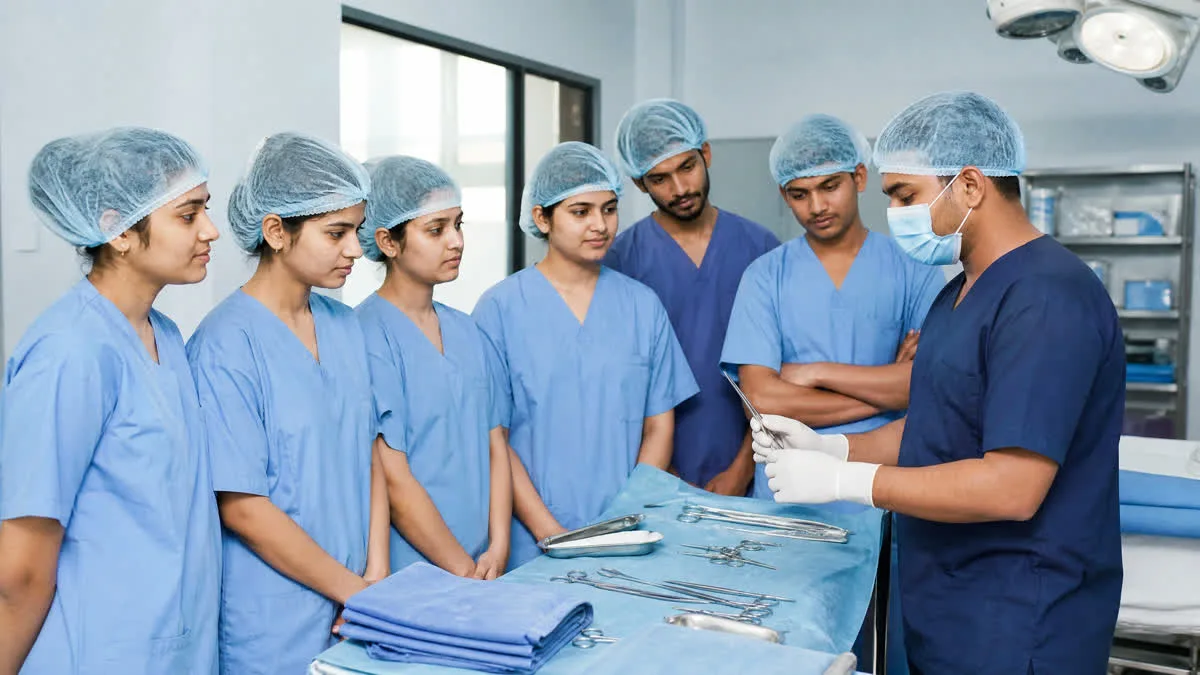
Behind every successful surgical procedure lies the invisible yet decisive expertise of the Operation Theatre Technician (OTT). From preparing delicate microsurgical instruments and maintaining uncompromised sterile fields to calibrating anesthesia workstations and assisting during critical surgical hemorrhages, surgical technologists are the right-hand professionals to surgeons and anesthesiologists inside major operating rooms.
Philadelphia Mission Hospital Surgical Suites • OSPMC Ambala. Below is the visual clinical protocol flowchart:
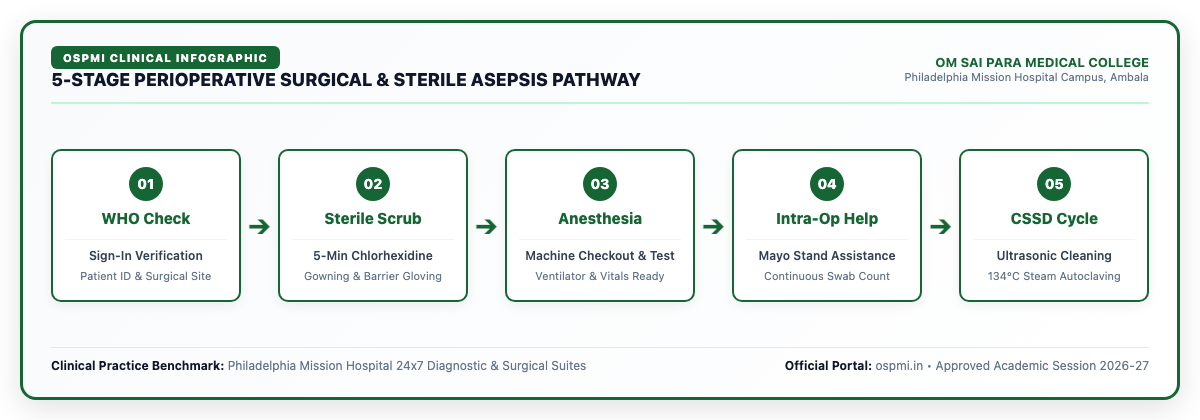
| Stage | Perioperative Phase | Clinical Equipment / Tools | Patient Safety Benchmark |
|---|---|---|---|
| 01. Briefing | Sign-In before induction of anesthesia | WHO Surgical Safety Checklist documentation | 100% correct site, patient, and procedure sign-off |
| 02. Asepsis | 5-minute surgical hand scrub & sterile barrier PPE | Chlorhexidine 4% scrub & fluid-resistant gowns | Zero sterile field contamination |
| 03. Anesthesia | Pre-use ventilator circuit & gas pipeline verification | Datex-Ohmeda workstation & multi-parameter monitors | Continuous EtCO2 & hemodynamic vitals monitoring |
| 04. Surgery | Mayo instrument stand passing & continuous sponge audit | Stryker Laparoscopy, ESU cautery, C-Arm imaging | Pre-closure instrument count 100% verified |
| 05. Reprocessing | Enzymatic pre-cleaning, packing & high-pressure steam cycle | Horizontal steam autoclave & biological spore test | Sterility assurance level (SAL) 10^-6 achieved |
At Om Sai Para Medical College (OSPMC), Ambala, operating within the active surgical ecosystem of Philadelphia Mission Hospital since 2004, students receive direct clinical training inside live surgical suites, mastering the high-stakes discipline of operative surgery.
Inside the Modern Surgical Suite: Roles of an OTT Technologist
An Operation Theatre Technician's responsibilities begin hours before a surgery commences and continue well after the patient is safely transferred to the post-anesthesia recovery unit:
- Pre-Operative OT Preparation: Verifying laminar airflow sterility, checking medical gas pipeline pressures (Oxygen, Nitrous Oxide, Medical Air), setting up surgical lights, and ensuring electrosurgical grounding pads are ready.
- Sterile Field & Instrument Setup: Assembling specialized instrument trays—such as laparoscopy towers, orthopaedic drills, neurosurgical rongeurs, and vascular clamps—following strict aseptic draping protocols.
- Anesthesia Support: Assisting the anesthesiologist during rapid sequence endotracheal intubation, spinal subarachnoid blocks, and epidural placements; priming intravenous fluid warmers and arterial lines.
- Intra-Operative Scrub Assistance: Passing sterile instruments to the surgeon with speed and anticipatory precision, managing suction tips, maintaining swab counts, and handling biopsy specimens.
- Post-Operative Decontamination & CSSD: Decontaminating sharp instruments, running ultrasonic cleaning cycles, packing sterile pouches, and overseeing autoclave sterilization runs.
Core Curriculum & Clinical Modules
The OTT academic curriculum is structured to develop high-pressure clinical agility across surgical disciplines:
- Surgical Microbiology & Asepsis: Pathophysiology of surgical site infections (SSI), chemical disinfectants, enzymatic cleaning, autoclave validation tests (Bowie-Dick test, biological spore indicators), and ethylene oxide (ETO) gas sterilization.
- Anesthesia Equipment & Workstations: Operation of modern anesthesia ventilators, vaporizers, circle absorber breathing systems, multipara vital monitors, capnography (EtCO2), and pulse oximetry.
- Specialized Surgical Specialties: Surgical assistance protocols across General Laparoscopic Surgery, Caesarean Deliveries, Orthopaedic Joint Replacements, ENT Microsurgery, and Ophthalmic Phacoemulsification.
- Emergency Life Support & Resuscitation: Basic Life Support (BLS), Advanced Cardiovascular Life Support (ACLS) protocols, cardiopulmonary resuscitation (CPR), biphasic defibrillation, and crash cart management.
Career Opportunities & Hospital Demand
With the rapid growth of superspecialty hospitals, trauma centers, and day-care laparoscopic surgical centers across Haryana, Punjab, and NCR, the demand for qualified OT technologists is at an all-time high:
- Chief Surgical Technologist: Heading major operating suites in multi-specialty hospitals (Max, Fortis, Medanta). Average starting salary: ₹2.8 Lakh to ₹5 Lakh / year.
- Anesthesia Support Specialist: Specialized technician assisting senior cardiac and neuro-anesthesiologists during high-risk surgical cases.
- Central Sterile Supply Department (CSSD) Manager: Managing hospital-wide sterilization protocols and infection control audits under NABH compliance standards.
- International Surgical Technologist: Extreme demand across private healthcare groups in Dubai, Abu Dhabi, Saudi Arabia, and the UK, with packages exceeding ₹10 Lakh to ₹18 Lakh / year.
Frequently Asked Questions (FAQs)
Q1: Is an Operation Theatre Technician course suitable for students who faint at the sight of blood?
Clinical exposure at OSPMC gradually builds psychological resilience and professional desensitization. Under supportive mentorship at Philadelphia Mission Hospital, students comfortably transition into confident surgical team members.
Q2: What is the eligibility criteria for OTT courses at OSPMC?
Candidates who have passed 10th or 10+2 from any recognized board are eligible for the Diploma program. Students with 10+2 Science (PCB) are eligible for the 3-Year B.Voc or 4-Year B.Sc programs.
Q3: Does OSPMC offer placement assistance after OTT completion?
Yes. OSPMC maintains an active 100% placement counselling cell connecting graduates with leading hospitals, surgical nursing homes, and diagnostic surgical centers across Northern India.
Official 2026-27 Fee Structure and Installments
At Om Sai Para Medical College (OSPMC), Ambala, the annual tuition fee is payable in 3 installments every year:
• Diploma Programs (DMLT, OTT, Optometry, Dialysis, Cath Lab): ₹50,000 / year (₹15,000 + ₹17,500 + ₹17,500)
• B.Voc Degree Programs: ₹55,000 / year (₹15,000 + ₹20,000 + ₹20,000)
• B.Sc Degree Programs and BMLS: ₹60,000 / year (₹20,000 + ₹20,000 + ₹20,000)
• Admission form: ₹2,000 (one time). Examination fee: ₹1,000 per semester (Diploma, B.Voc), ₹2,000 per semester (B.Sc, BMLS)
0 comments
Be the first to comment on this article.