
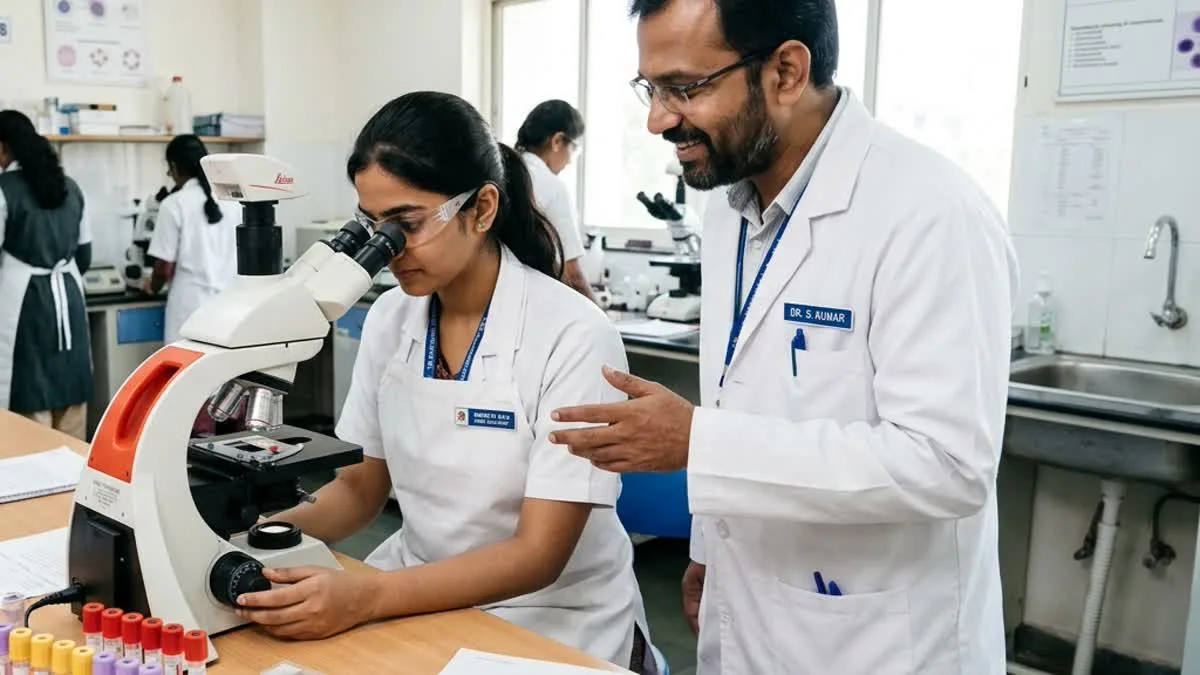
Choosing the right medical laboratory qualification after 12th is one of the most critical decisions for students entering the paramedical sciences. The two most popular diagnostic pathways in India are the 2-Year Diploma in Medical Laboratory Technology (DMLT) and the 3 to 4-Year Bachelor of Science in Medical Laboratory Technology (B.Sc MLT). While both programs train students for vital roles in pathology and diagnostic medicine, their academic depth, government pay scales, and long-term career trajectories differ significantly.
Philadelphia Mission Hospital Diagnostic Laboratory SOP • OSPMC Ambala. Below is the visual clinical protocol flowchart:
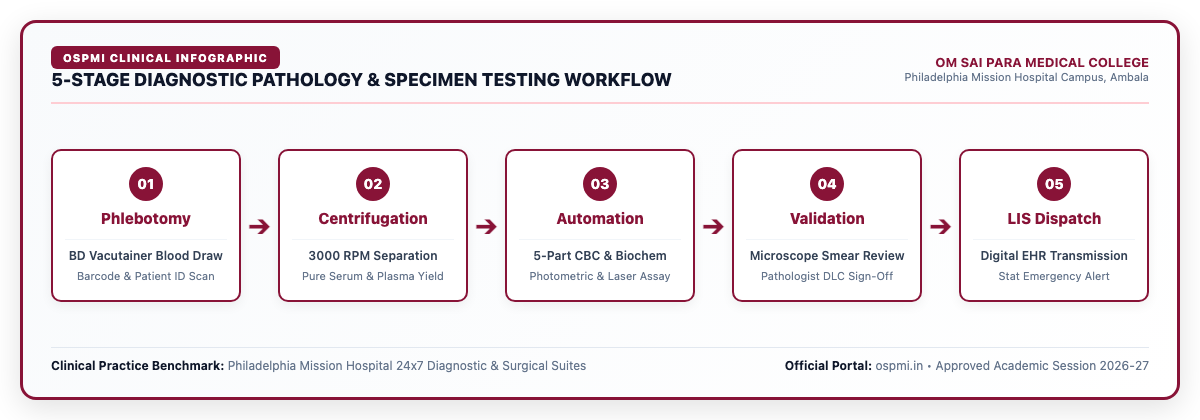
| Stage | Clinical Operation | Diagnostic Machinery Used | Quality Control Benchmark |
|---|---|---|---|
| 01. Collection | Barcoded vacuum blood draw (EDTA, Heparin, Fluoride) | BD Vacutainer multi-sample safety needles | Zero pre-analytical hemolysis rate |
| 02. Processing | High-speed refrigerated component centrifugation | Digital refrigerated clinical centrifuge | Complete cellular separation in 10 mins |
| 03. Analysis | Quantitative photometric & laser flow cytometry | Erba Chem 5X & 5-Part Hematology Counter | Daily Levey-Jennings & Westgard rule check |
| 04. Verification | Peripheral blood smear examination & anomaly confirmation | Trinocular oil-immersion 1000x microscope | Senior Pathologist double-read sign-off |
| 05. Dispatch | LIS electronic delivery & emergency panic value alerts | Integrated Hospital Laboratory Information System | < 45 mins TAT for Stat emergency ICU labs |
At Om Sai Para Medical College (OSPMC), Ambala, operating within the Philadelphia Mission Hospital campus, we guide students through both pathways. Here is an exhaustive, unbiased comparative breakdown to help you make an informed choice.
Core Difference: Program Philosophy & Academic Scope
The fundamental distinction between DMLT and B.Sc MLT lies in training philosophy:
- DMLT (2 Years): A practical, fast-track diploma structured for rapid entry into the healthcare workforce. It prioritizes hands-on diagnostic techniques—sample collection (phlebotomy), routine hematological testing, basic clinical biochemistry, and standard bacteriological staining.
- B.Sc MLT (3 to 4 Years): A comprehensive undergraduate scientific degree. In addition to core diagnostic procedures, it explores advanced molecular genetics, polymerase chain reaction (PCR) diagnostics, flow cytometry, immunohistochemistry, and clinical laboratory administration.
Detailed Comparative Matrix
- Course Duration: DMLT requires 2 academic years. B.Sc MLT requires 3 academic years plus a 6-month to 1-year compulsory rotational hospital internship.
- Entry Eligibility: DMLT is open to 10+2 candidates from any recognized stream (Science preferred, minimum 45% marks). B.Sc MLT strictly requires 10+2 with Physics, Chemistry, and Biology (PCB) with 45-50% aggregate marks.
- Academic Level: DMLT is a vocational paramedical diploma. B.Sc MLT is a full undergraduate bachelor's degree recognized by UGC and the National Commission for Allied and Healthcare Professions (NCAHP).
- Government Job Scale: DMLT graduates qualify for Junior Technician and Lab Assistant posts in state civil hospitals and railway health units. B.Sc MLT graduates qualify for Senior Medical Technologist, Laboratory Scientist, and Technical Officer posts with higher pay bands (Level 6 / 7 in central hospitals like AIIMS and PGI).
- Higher Education Pathways: DMLT holders can enter degree programs through lateral entry into the 2nd year of B.Voc or B.Sc. B.Sc MLT graduates are directly eligible for Master's programs (M.Sc in Medical Microbiology, Medical Biochemistry, or Pathology) and eventual Ph.D. research.
Syllabus & Clinical Machinery Comparison
While both courses share foundational subjects like Anatomy and Basic Hematology, B.Sc MLT dives into advanced diagnostic automation:
- Clinical Biochemistry: DMLT covers semi-automated colorimeters, routine LFT, and KFT. B.Sc MLT adds fully automated high-throughput chemistry analyzers, arterial blood gas (ABG) analyzers, and chemiluminescence immunoassays (CLIA) for hormonal profiling.
- Microbiology & Serology: DMLT covers Gram stain, AFB stain, and Widal tests. B.Sc MLT adds automated blood culture systems (BACTEC), Minimum Inhibitory Concentration (MIC) antimicrobial testing, and viral load quantification.
- Histopathology: DMLT covers basic tissue fixation and microtome sectioning. B.Sc MLT covers frozen section cryostat operation, immunohistochemical staining, and cytological specimen preservation.
Salary Expectations & Career Progression
- Freshers' Starting Compensation: DMLT freshers typically start at ₹18,000 to ₹25,000 per month in private diagnostic chains and regional hospitals. B.Sc MLT freshers start at ₹25,000 to ₹38,000 per month in tertiary care hospitals and corporate diagnostic labs.
- Mid-Career Outlook (5+ Years Experience): Experienced DMLT technicians earn ₹35,000 to ₹50,000 per month as senior phlebotomists or lab in-charges. B.Sc MLT scientists earn ₹60,000 to ₹95,000+ per month as laboratory managers, quality managers (NABL), or diagnostic application specialists.
- Overseas Migration: For international healthcare systems (NHS UK, DHA Dubai, MOH Saudi Arabia), candidates with a 3 to 4-year bachelor's degree (B.Sc MLT) encounter streamlined verification (DataFlow) and higher visa approval rates compared to 2-year diploma holders.
Verdict: Which Course Should You Choose?
- Choose DMLT If: You want to start working in a hospital or pathology lab as early as possible, have budget constraints, or want to quickly establish a stable career in 2 years with flexible lateral entry options later.
- Choose B.Sc MLT If: You have completed 12th Science with Biology, aim for senior supervisory or government laboratory posts (AIIMS, PGI), plan to pursue Master's/Ph.D. research, or have ambitions to migrate abroad as a certified medical laboratory scientist.
Official 2026-27 Fee Structure and Installments
At Om Sai Para Medical College (OSPMC), Ambala, the annual tuition fee is payable in 3 installments every year:
• Diploma Programs (DMLT, OTT, Optometry, Dialysis, Cath Lab): ₹50,000 / year (₹15,000 + ₹17,500 + ₹17,500)
• B.Voc Degree Programs: ₹55,000 / year (₹15,000 + ₹20,000 + ₹20,000)
• B.Sc Degree Programs and BMLS: ₹60,000 / year (₹20,000 + ₹20,000 + ₹20,000)
• Admission form: ₹2,000 (one time). Examination fee: ₹1,000 per semester (Diploma, B.Voc), ₹2,000 per semester (B.Sc, BMLS)
0 comments
Be the first to comment on this article.