
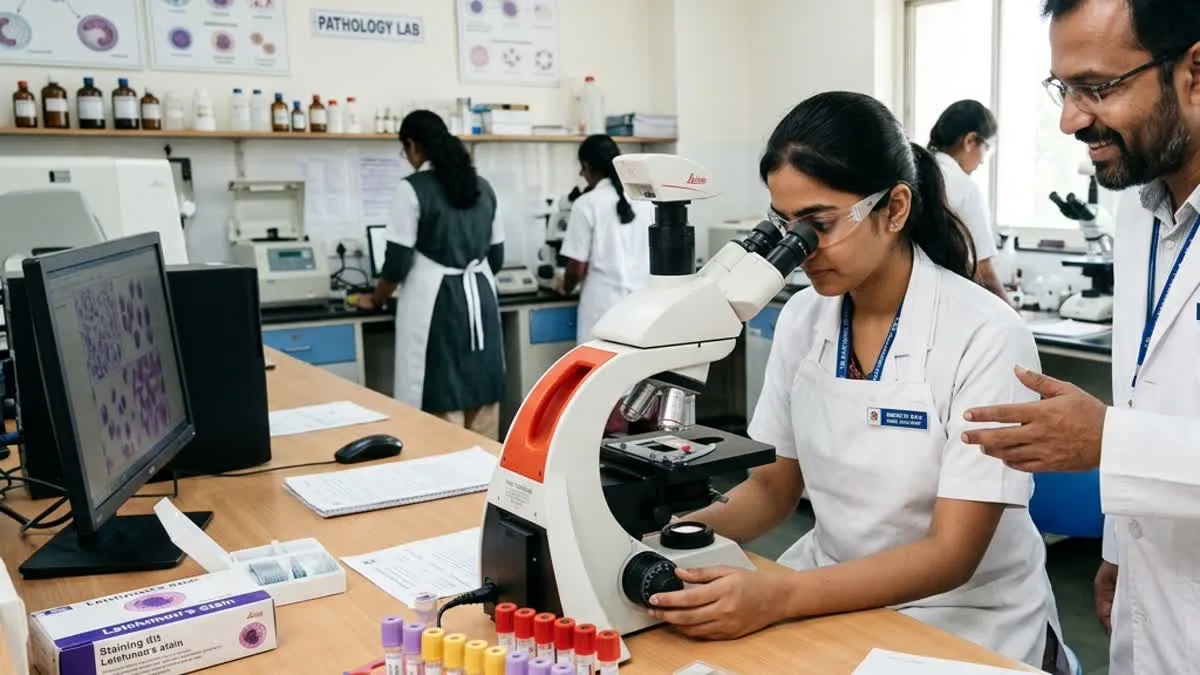
Medical Laboratory Technology is a precision-driven scientific discipline. To produce technicians who can deliver error-free diagnostic results under emergency conditions, the Diploma in Medical Laboratory Technology (DMLT) curriculum is crafted with rigorous clinical depth. Here is an exhaustive year-wise breakdown of theoretical subjects, practical laboratory postings, and examination patterns.
Philadelphia Mission Hospital Diagnostic Laboratory SOP • OSPMC Ambala. Below is the visual clinical protocol flowchart:
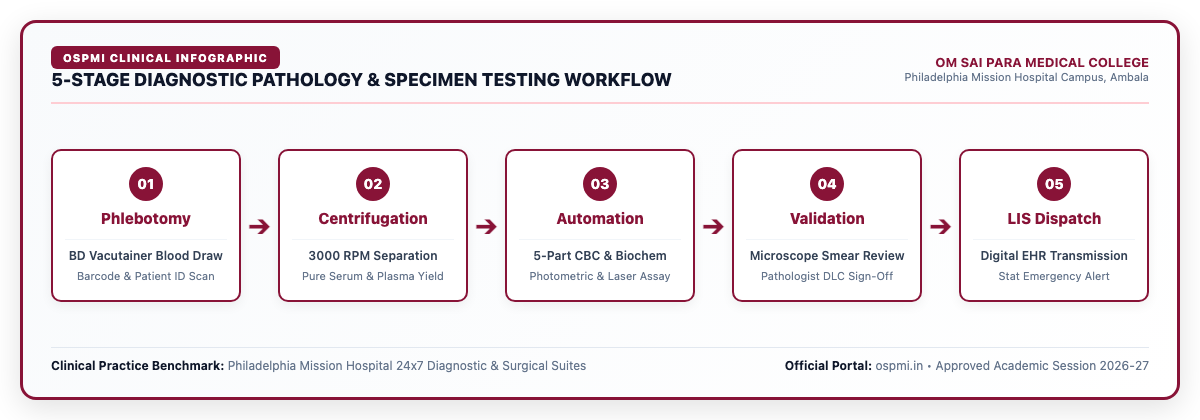
| Stage | Clinical Operation | Diagnostic Machinery Used | Quality Control Benchmark |
|---|---|---|---|
| 01. Collection | Barcoded vacuum blood draw (EDTA, Heparin, Fluoride) | BD Vacutainer multi-sample safety needles | Zero pre-analytical hemolysis rate |
| 02. Processing | High-speed refrigerated component centrifugation | Digital refrigerated clinical centrifuge | Complete cellular separation in 10 mins |
| 03. Analysis | Quantitative photometric & laser flow cytometry | Erba Chem 5X & 5-Part Hematology Counter | Daily Levey-Jennings & Westgard rule check |
| 04. Verification | Peripheral blood smear examination & anomaly confirmation | Trinocular oil-immersion 1000x microscope | Senior Pathologist double-read sign-off |
| 05. Dispatch | LIS electronic delivery & emergency panic value alerts | Integrated Hospital Laboratory Information System | < 45 mins TAT for Stat emergency ICU labs |
Year 1: Pre-Clinical Sciences & Foundational Laboratory Skills
1. Clinical Hematology & Blood Banking
Complete blood count techniques, Neubauer chamber hemocytometry, Westergren and Wintrobe ESR estimation, peripheral blood smear preparation, Leishman and Wright staining, reticulocyte counts, and ABO/Rh blood grouping and cross-matching.
2. Clinical Pathology & Body Fluids
Routine physical and chemical urine examination (Benedict's, heat coagulation, dipstick), microscopic examination of urine sediment (casts, crystals, cells), stool routine examination for parasites, and seminal fluid analysis.
3. General Anatomy & Medical Physiology
Microscopic tissue structures, circulatory and cardiovascular anatomy, respiratory mechanisms, renal filtration, and the endocrine system.
Year 2: Advanced Diagnostics & Clinical Microbiology
1. Clinical Biochemistry
Blood glucose estimation (enzymatic GOD-POD method), kidney function tests (BUN, Serum Creatinine, Uric Acid), liver function tests (Bilirubin total and direct, SGOT/AST, SGPT/ALT, Alkaline Phosphatase), and automated chemistry analyzer calibration.
2. Medical Microbiology & Serology
Bacterial culture media preparation (Nutrient Agar, Blood Agar, MacConkey Agar), Gram stain, Acid-Fast Bacillus (AFB) Ziehl-Neelsen stain for tuberculosis, antibiotic disc diffusion susceptibility testing, Widal slide and tube agglutination, and ELISA screening for HIV, HBsAg, and HCV.
3. Histotechnology & Cytology
Tissue grossing assist, formalin fixation, paraffin wax block embedding, rotary microtome section cutting, and Hematoxylin & Eosin (H&E) staining.
Official 2026-27 Fee Structure and Installments
At Om Sai Para Medical College (OSPMC), Ambala, the annual tuition fee is payable in 3 installments every year:
• Diploma Programs (DMLT, OTT, Optometry, Dialysis, Cath Lab): ₹50,000 / year (₹15,000 + ₹17,500 + ₹17,500)
• B.Voc Degree Programs: ₹55,000 / year (₹15,000 + ₹20,000 + ₹20,000)
• B.Sc Degree Programs and BMLS: ₹60,000 / year (₹20,000 + ₹20,000 + ₹20,000)
• Admission form: ₹2,000 (one time). Examination fee: ₹1,000 per semester (Diploma, B.Voc), ₹2,000 per semester (B.Sc, BMLS)
0 comments
Be the first to comment on this article.