
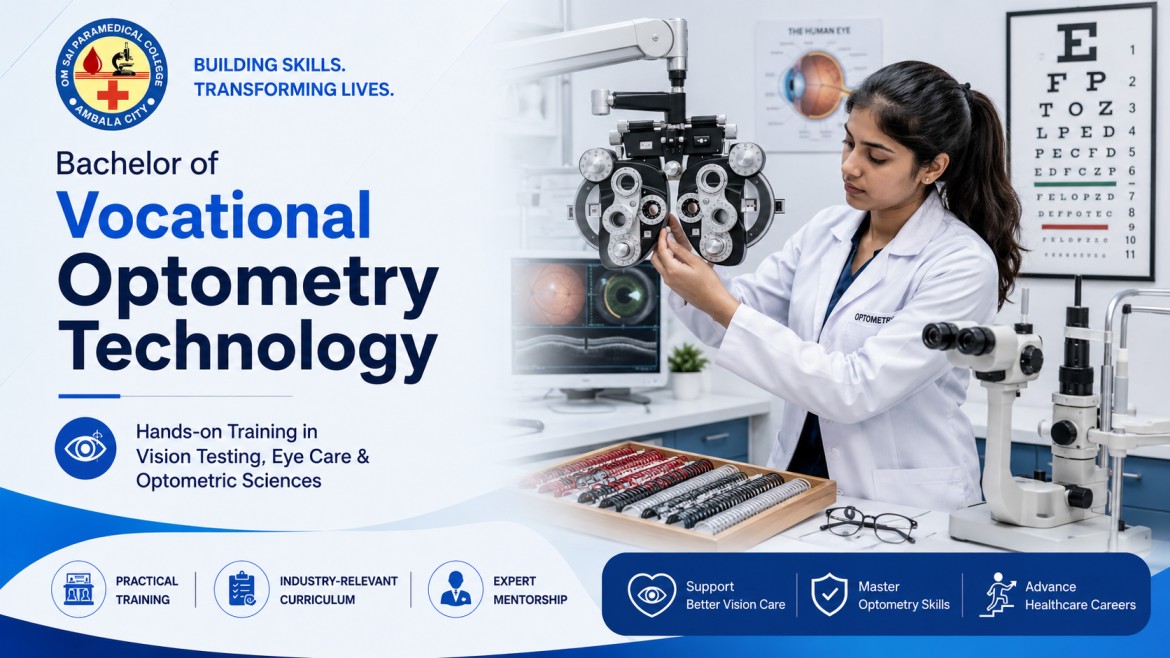
What is the Purpose of This Course?
The Bachelor of Vocational (B.Voc.) Optometry Technology program is designed to prepare students with the knowledge and practical skills required for vision care, eye examination procedures, optical technology, and eye health management. The course focuses on developing competencies in vision assessment, refractive error detection, optical dispensing, contact lens technology, and assisting ophthalmologists in providing quality eye care services.
Optometry professionals play an important role in healthcare by helping identify visual disorders, supporting eye disease screening, and improving patients’ visual health through diagnostic and corrective procedures. This vocational program combines academic learning with practical clinical training to prepare students for careers in eye care and vision science.
Course Details
This course combines classroom education, laboratory training, and clinical exposure. Students will gain expertise in:
Vision Assessment Techniques – Learning methods for vision examination and visual acuity testing.
Eye Anatomy & Physiology – Understanding eye structure and visual system functions.
Refraction Techniques – Identifying refractive errors and vision correction methods.
Optical Instruments Handling – Operating ophthalmic diagnostic instruments.
Contact Lens Technology – Understanding contact lens fitting and care procedures.
Optical Dispensing – Learning lens selection, frame fitting, and prescription interpretation.
Eye Disease Screening Support – Assisting in identifying common eye disorders.
Patient Care & Communication – Developing professional interaction and patient management skills.
Clinical Eye Examination Procedures – Understanding eye testing protocols and vision assessment methods.
Practical Training & Clinical Internship – Real-world exposure in vision care settings.
Eligibility Criteria
To enroll in Bachelor of Vocational Optometry Technology, candidates should fulfill the following eligibility requirements:
Educational Qualification – 10+2 (Intermediate) with Science stream (PCB/PCM preferred).
Minimum Qualification Requirement – As per university or institutional admission guidelines.
Interest in Vision Care & Healthcare Technology – Candidates interested in eye healthcare and optical sciences are encouraged to apply.
Basic Scientific Understanding – Knowledge of Biology and Physics is beneficial.
Scope of This Course
Optometry Technology professionals are increasingly needed in eye care and healthcare services.
Career opportunities include:
Optometry Technician
Assist with vision testing and optical procedures.
Vision Care Assistant
Support eye care professionals in patient examination procedures.
Optical Technician
Assist in optical lens dispensing and frame fitting.
Eye Clinic Assistant
Provide support in ophthalmology and vision care facilities.
Contact Lens Technician
Assist in contact lens assessment and fitting support.
Optical Store Professional
Manage prescription eyewear and customer vision care services.
Vision Screening Technician
Support vision testing programs and community healthcare services.
Employment opportunities are available in:
- Eye Hospitals
- Optical Clinics
- Vision Care Centers
- Healthcare Institutions
- Ophthalmology Clinics
- Optical Retail Organizations
- Multi-specialty Hospitals
- Community Health Programs
Duration of the Course
The Bachelor of Vocational Optometry Technology program generally includes:
Degree Duration – 3 Years
The course includes classroom learning, laboratory practical sessions, clinical exposure, and internship training.
Course Subjects
First Year Subjects
- Human Anatomy & Physiology
- Fundamentals of Optometry
- Ocular Anatomy & Physiology
- Basic Vision Science
- Medical Terminology
- Communication Skills
- Computer Fundamentals
- Practical Laboratory Training
Second Year Subjects
- Refraction Techniques
- Optical Dispensing
- Contact Lens Technology
- Ophthalmic Instruments
- Binocular Vision
- Ocular Disease Fundamentals
- Clinical Optometry Procedures
- Clinical Training
Third Year Subjects
- Advanced Optometry Technology
- Vision Therapy Basics
- Community Eye Health
- Patient Management
- Healthcare Ethics
- Practice Management
- Research Project
- Clinical Internship
Syllabus of the Course
Module 1: Introduction to Optometry Technology
- Introduction to eye care systems
- Scope of optometry technology
- Healthcare communication
- Professional ethics
- Patient care principles
Module 2: Human Anatomy & Ocular Physiology
- Human body systems
- Structure of the eye
- Visual pathway
- Eye muscles and functions
- Physiology of vision
Module 3: Vision Assessment Techniques
- Visual acuity testing
- Eye examination methods
- Color vision assessment
- Binocular vision evaluation
- Visual field assessment
Module 4: Refraction & Optical Technology
- Principles of refraction
- Refractive errors
- Lens measurement techniques
- Spectacle prescription interpretation
- Optical correction methods
Module 5: Ophthalmic Instruments
- Slit lamp basics
- Retinoscope handling
- Ophthalmoscope basics
- Lensometer operation
- Diagnostic instrument maintenance
Module 6: Contact Lens Technology
- Contact lens types
- Contact lens fitting principles
- Lens care procedures
- Patient guidance and maintenance
Module 7: Ocular Disease Fundamentals
- Common eye disorders
- Cataract awareness
- Glaucoma awareness
- Diabetic eye complications
- Eye infection basics
Module 8: Optical Dispensing & Patient Care
- Lens dispensing techniques
- Frame selection and fitting
- Prescription verification
- Patient counseling procedures
Module 9: Healthcare Ethics & Quality Standards
- Professional ethics
- Healthcare documentation
- Safety procedures
- Quality assurance standards
Module 10: Clinical Internship & Practical Training
- Eye clinic exposure
- Vision testing practice
- Optical laboratory training
- Clinical case observations
- Internship in healthcare institutions
Practical Training Included
Students receive practical exposure in:
- Vision Assessment Procedures
- Refraction Testing
- Ophthalmic Equipment Handling
- Optical Dispensing
- Contact Lens Support Procedures
- Patient Communication
- Vision Screening Programs
- Clinical Eye Examination Support
Skills Developed During the Course
Students will develop:
- Vision Assessment Skills
- Technical Instrument Handling Skills
- Patient Care Competencies
- Optical Dispensing Knowledge
- Communication Skills
- Clinical Support Skills
- Professional Healthcare Ethics
- Problem Solving Ability
Career Opportunities After Completion
Graduates may work as:
- Optometry Technician
- Vision Care Assistant
- Optical Technician
- Eye Clinic Assistant
- Ophthalmic Support Professional
- Optical Retail Professional
- Contact Lens Technician
- Vision Screening Technician
Why Choose OSPMC?
At OSPMC, we focus on practical healthcare education with industry-oriented skill development.
Experienced Faculty – Learn from healthcare educators and vision care professionals.
Practical Clinical Exposure – Hands-on training and healthcare experience.
Industry-Focused Curriculum – Updated learning aligned with healthcare requirements.
Modern Training Facilities – Practical laboratory and clinical learning.
Recognition – Degree awarded by Lingaya’s Vidyapeeth University.
Career Guidance Support – Internship and placement guidance.
Affordable Fee Structure – Quality vocational education with practical learning.
Skill-Based Education – Focus on employability and professional development.